

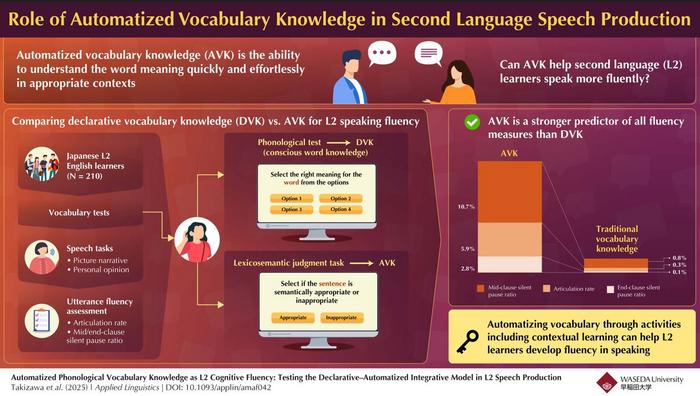
Speaking fluently in a second language depends more on how quickly you can retrieve words in context than simply knowing their meanings, according to research examining 210 Japanese university students learning English.
The study, published in Applied Linguistics, found that automatized vocabulary knowledge—the ability to instantly access and use words appropriately in sentences—was 10 times more predictive of speaking fluency than traditional vocabulary memorization. This challenges conventional language teaching that emphasizes memorizing word lists over contextual practice.
Beyond Dictionary Knowledge
“Our study addressed an outstanding question regarding the vocabulary knowledge that best supports automaticity in second language speech production,” explains Kotaro Takizawa from Waseda University, who led the research.
The difference is like knowing a recipe versus being able to cook without thinking. Someone might memorize that “appreciated” means “valued,” but fluent speakers automatically know it fits in “I really appreciated his support” while instantly rejecting “My friend’s estate was very kind.”
Testing Two Types of Knowledge
Researchers assessed vocabulary knowledge using two distinct methods. For declarative vocabulary knowledge (DVK), students matched spoken English words with Japanese meanings—testing basic memorized connections. For automatized vocabulary knowledge (AVK), participants heard sentences and judged whether they made sense, requiring real-time contextual processing.
Students then completed two speaking tasks:
- A picture narrative requiring specific vocabulary to describe predetermined content
- A personal monologue about life challenges, allowing more flexibility in word choice
Speech fluency was measured through articulation rate and the location of silent pauses—whether they occurred mid-clause (indicating word retrieval difficulty) or at clause boundaries (reflecting normal planning).
The Power of Automatization
AVK emerged as a significantly stronger predictor across all fluency measures. Most strikingly, it explained 10.7% of variance in mid-clause pauses compared to just 0.8% for traditional vocabulary knowledge. These mid-clause hesitations—pausing while searching for words—are what distinguish second language speakers from native speakers.
The effect was particularly pronounced in the picture narrative task, which demanded specific vocabulary. Students with higher AVK maintained fluency even when constrained by predetermined content, while those relying on declarative knowledge struggled more.
Parallel Processing Advantage
The findings support Levelt’s speech production model, where speaking involves simultaneous conceptualization, formulation, and articulation. Automatized knowledge enables this parallel processing—while articulating one word, the brain already prepares the next.
Students with robust AVK showed this advantage through higher articulation rates (5.9% variance explained versus 0.3% for DVK) and fewer end-clause pauses (2.8% versus 0.1%). Even working memory capacity, measured through digit span tasks, couldn’t account for these differences.
Lexicosemantic Judgment Innovation
A technical innovation not mentioned elsewhere involved the scoring system for the lexicosemantic judgment task. Participants earned points only if they correctly identified both appropriate and inappropriate uses of each target word—ensuring they truly understood contextual boundaries rather than guessing.
The 160 test sentences used primarily high-frequency surrounding words (93% from the 1,000-word family) to isolate the effect of target word knowledge. This design prevented confusion from complex grammar or unfamiliar context words.
Implications for Language Learning
The research suggests language learners should progress beyond flashcards to encountering words repeatedly in varied contexts. Reading, listening to podcasts, and watching videos provide the contextual exposure needed to automatize vocabulary.
“Building simple form-meaning connections is only the first step,” concludes Takizawa. “To become orally fluent, learners need to automatize these connections through consistent practice and meaningful exposure.”
For educators, this means incorporating timed exercises that gradually increase processing demands—from recognizing words to using them in increasingly complex contexts. The goal isn’t just knowing what words mean, but accessing them as automatically as reaching for a fork when eating.