

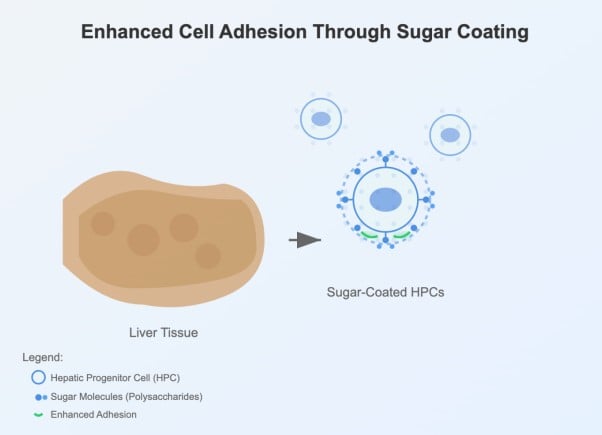
Scientists have developed a method to make liver repair cells “stickier” by coating them with natural sugars, potentially offering an alternative to organ transplants for patients with severe liver disease.
The technique addresses a critical problem in regenerative medicine: therapeutic cells often fail to stay in place long enough to repair damaged tissue. By wrapping hepatic progenitor cells (HPCs) in molecules like hyaluronic acid and alginate, researchers at the University of Birmingham achieved dramatically improved cell adhesion without genetic modification.
The Sticking Problem
HPCs can transform into functioning liver cells and help regenerate damaged tissue. But when doctors inject these cells into patients, most wash away before they can attach to existing liver tissue. It’s like trying to patch a leaky boat while water keeps pushing the repair material away.
“Liver transplants are the only option for many severe liver diseases, but there aren’t enough donor livers available,” explains Dr. Maria Chiara Arno, who led the research. “This method could provide an alternative by making cell therapy more effective, potentially helping many people with liver disease.”
How the Sugar Coating Works
The team used a process called metabolic oligosaccharide engineering (MOE) to attach polysaccharides to the cell surface. These sugar molecules act like molecular velcro, helping cells grip onto their surroundings.
Key improvements in coated cells included:
- Enhanced spreading and formation of adhesive structures
- Increased production of integrins (proteins that help cells attach)
- Preferential binding to specific extracellular matrix proteins
- Stronger attachment to blood vessel lining cells
- Better integration with 3D liver tissue models
Temporary Enhancement, Lasting Benefits
The sugar coating is designed to be temporary, lasting just long enough for cells to establish themselves after transplantation. This timing is crucial—the coating helps cells settle in without interfering with their long-term function.
Laboratory tests confirmed that coated HPCs maintained their ability to differentiate into mature liver cells and produce essential proteins. The cells showed no signs of damage or dysfunction from the coating process.
Testing on Living Tissue Models
Researchers tested the sticky cells on advanced 3D liver microtissues that mimic human organ conditions. Coated HPCs demonstrated significantly higher adhesion rates compared to uncoated cells when applied to these miniature liver models.
The team also examined how coated cells interacted with endothelial cells, which line blood vessels throughout the liver. This interaction is critical because therapeutic cells must navigate the vascular system to reach damaged areas.
Click Chemistry Innovation
A notable technical detail involves the use of “click chemistry”—a precise molecular linking method that won the 2022 Nobel Prize. This approach allows researchers to attach sugar molecules to cells through specific chemical reactions that work like molecular snaps, ensuring uniform coating without damaging the cells.
The click-mediated functionalization creates homogeneous surface modifications, meaning each cell receives consistent coating coverage. This uniformity could prove essential for clinical applications where treatment standardization matters.
Beyond Genetic Modification
“Our approach avoids genetic modification, making it easier to use in the clinic,” notes Arno. Traditional methods often require altering cellular DNA, which raises safety concerns and regulatory hurdles.
The sugar-coating technique could potentially work with other therapeutic cell types. Researchers plan to investigate its effects on immune responses and long-term cell health in living organisms.
With liver disease affecting millions worldwide and transplant waiting lists growing longer, this sticky solution might help more patients receive effective treatment without surgery. The research appears in Communications Biology.