

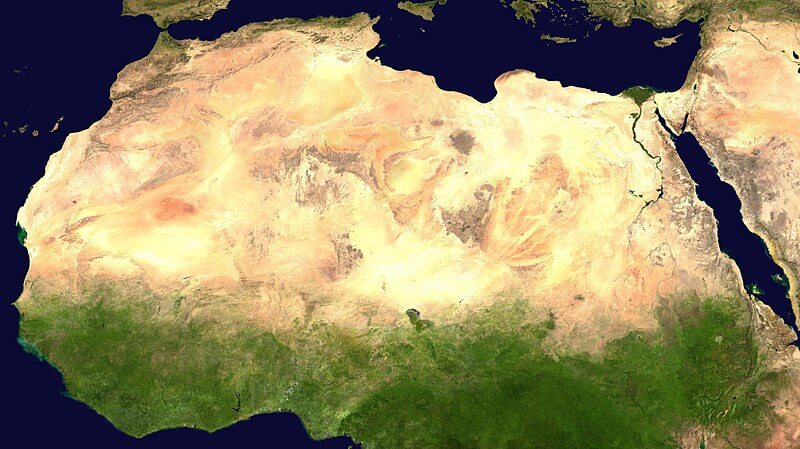
Heat shimmers above pale dunes, then the sky lets go. That is the future some climate models now sketch for parts of the Sahara, where rain has long been a rare visitor. In a new analysis from the University of Illinois Chicago, researchers report that summer precipitation across Africa is projected to rise by later this century, with the Sahara showing the most dramatic change.
The study, published in npj Climate and Atmospheric Science, examines a 50 year future period from 2050 to 2099 against a 1965 to 2014 baseline. Using an ensemble of 40 CMIP6 models and two emissions scenarios, a moderate pathway and a very high one, the team finds continental scale increases in rainfall with sharp regional contrasts. The standout number is a projected 75 percent rise in the Sahara. Southeastern Africa increases by about 24 to 25 percent, South Central Africa by roughly 17 percent, while West Southern Africa edges drier by about 5 percent.
“Changing rainfall patterns will affect billions of people, both in and outside Africa,” said lead author Thierry Ndetatsin Taguela. “We have to start planning to face these changes, from flood management to drought-resistant crops.”
Mechanistically, the wetter signal is mostly thermodynamic. Warmer air holds more moisture, which primes the atmosphere for heavier rains once convection initiates. The authors quantify this with a moisture budget framework that separates thermodynamic effects, tied to specific humidity increases driven by temperature, from dynamic effects, tied to circulation. In many regions, the vertical thermodynamic term dominates the increase in rainfall. The Sahara’s story adds a twist, with horizontal dynamic changes and evaporation also contributing.
Drying in West Southern Africa reflects a different lever. There, models project a weakening of the ascending branch of the Hadley circulation during the austral summer. That dynamic shift suppresses convection even as near surface temperatures rise, which offsets the moisture boost and tilts the balance toward less rain.
What The Models Agree On, And What They Do Not
Agreement on the sign of change is robust in many places. At least 70 percent of models point the same way for ensemble mean changes across key grids. Yet the amplitude remains uncertain. The authors decompose uncertainty into three sources, model, scenario, and internal variability. Model uncertainty dominates across Africa and grows with lead time, accounting for more than 85 percent of total variance by century’s end. The culprits are familiar to tropical meteorologists, subgrid parameterizations for deep and shallow convection, cloud microphysics, and boundary layer turbulence. Scenario differences matter most late in the century for a few regions. Internal variability fades with time and is small by comparison.
I was struck by a subtle result. The processes that drive the mean increase are not the same as those that drive model spread. Vertical thermodynamics push the average wetter, but the intermodel differences correlate more strongly with vertical dynamics, that is, how circulation changes are represented. In plain terms, models can agree that a wetter future is likely, while disagreeing on how much because they differ in how vertical motion and convective organization respond to warming.
“The Sahara is projected to almost double its historical precipitation levels, which is surprising for such a climatologically dry region,” Taguela said.
For planners, the signal is both opportunity and risk. More water could recharge aquifers and green seasonal pastures, but it also raises the odds of flash flooding, infrastructure damage, and disease outbreaks. The paper flags late summer intensification in several regions, a timing detail that matters for agriculture and reservoir operations. It also notes that convective precipitation remains the dominant share of totals across most of Africa, which implies short duration, high intensity events will be central to adaptation.
Implications For Adaptation And Next Steps
High leverage moves are clear. Invest in sub daily observing networks that capture convective storms. Calibrate flood models to short, intense rainfall rather than monthly means. Stress test food systems against both wetter and drier tails, especially in West Southern Africa where drying is likely. Expand efforts to improve convection and cloud microphysics in global models, since those choices drive most of the uncertainty and therefore most of the risk to decisions.
The authors also link parts of the spread to global mean surface warming and to equilibrium climate sensitivity. Models with higher sensitivity tend to amplify the thermodynamic moisture response. That does not settle the spread problem, but it does explain some of it, and it points to a broader truth. Better constraints on climate sensitivity and better representation of tropical convection will pay dividends for African hydroclimate projections.
The headline finding remains vivid. A desert defined by absence could see more frequent summer rains by late century, along with large increases across much of the continent. The water cycle is quickening. The task now is to make that speed legible to engineers, farmers, and city managers before the clouds gather.
npj Climate and Atmospheric Science: 10.1038/s41612-025-01123-8