

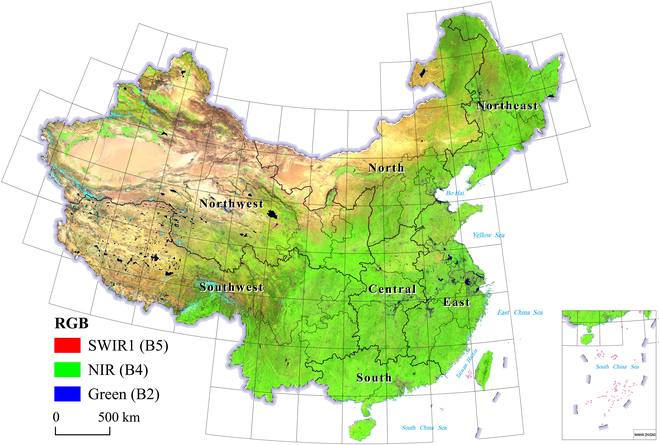
Chinese researchers have unveiled a powerful new tool for Earth observation: a 30-meter resolution Landsat composite data cube covering every year from 1985 to 2023.
The seamless dataset, described in the Journal of Remote Sensing, offers the first annual “Leaf-On” season satellite imagery for all of China. By solving long-standing issues with cloud cover, sensor inconsistencies, and data gaps, this resource could transform land use research, vegetation monitoring, and climate policy across the country.
Filling a Critical Data Gap
For years, Chinese scientists lacked a national equivalent to the U.S. Geological Survey’s Analysis Ready Data (ARD) for Landsat, forcing researchers to painstakingly process raw satellite data themselves. This new dataset, led by Dr. Yaotong Cai and colleagues, closes that gap with a ready-to-use annual composite tailored specifically to China’s ecological and remote sensing needs.
“This dataset is a significant breakthrough for environmental monitoring in China,” said Dr. Cai. “It not only simplifies satellite data processing but also provides a long-term resource for research on land use, climate change, and biodiversity conservation.”
What Makes This Dataset Different?
The data cube is built from Landsat 4, 5, 7, 8, and 9 imagery using a sophisticated processing chain within Google Earth Engine. The key innovation is a “medoid compositing” technique that selects the most representative pixel for each location and year, avoiding outliers and preserving spectral integrity. To fill in cloudy or missing areas, the team used segmented linear interpolation, generating proxy values that closely match real conditions.
- Temporal span: Annual data from 1985–2023
- Spatial resolution: 30 meters, nationwide coverage
- Cloud and shadow masking: Quality-assessed using CFMASK
- Data gap filling: Linear interpolation with breakpoint detection
- Sensor harmonization: Adjusted across multiple Landsat platforms
Tracking China’s Changing Landscape
Preliminary applications of the dataset show its potential for analyzing long-term land cover trends. In northwest China, researchers used the composites to document urban growth, forest regrowth, and shifts in agriculture over nearly four decades. Using machine learning models, they also mapped tree cover and aboveground biomass, capturing the effects of major afforestation campaigns.
Unlike older median-based composites, this data cube maintains consistent color and clarity year to year, even when switching between Landsat sensors. The result is a cleaner, more interpretable view of China’s terrain—ideal for national-scale research and decision-making.
Limitations and the Road Ahead
Despite its strengths, the dataset is not without caveats. Some areas with frequent cloud cover, such as southern China, remain challenging. And because the data only covers the Leaf-On season (roughly June to October), events outside the growing season may be missed. The authors also note that spectral harmonization methods derived from U.S. data may introduce small biases when applied across China’s diverse regions.
Still, the team plans to continue improving the dataset by integrating Sentinel-2 imagery, enhancing cloud detection algorithms, and eventually expanding to include leaf-off periods. The open-access format and annual update plan make it a promising backbone for environmental science in China—and potentially beyond.
A Tool for Science, Policy, and the Planet
With 39 years of continuous, harmonized satellite imagery, the new data cube gives researchers and policymakers unprecedented insight into how China’s ecosystems have changed—and how they might respond to future pressures. As climate change, urban expansion, and conservation efforts continue to reshape the landscape, this dataset could help keep track.
“By providing open and accessible data,” the authors write, “this resource will drive further research and innovation, enabling more accurate and timely studies that deepen our understanding of China’s dynamic environmental landscape.”
Journal and DOI
Published July 2, 2025 in Journal of Remote Sensing