

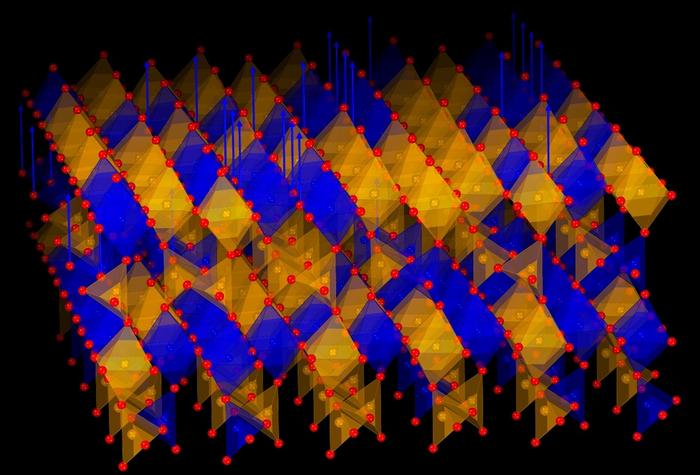
A crystal that inhales and exhales oxygen may change the future of energy. Scientists from Pusan National University in Korea and Hokkaido University in Japan have reported the discovery of a new metal oxide, SrFe0.5Co0.5O2.5, that can repeatedly release and reabsorb oxygen at relatively low temperatures without losing structural integrity. Published in Nature Communications, the study opens potential applications in fuel cells, smart windows, and next-generation electronics.
Breathing materials for cleaner energy
Most crystals that can exchange oxygen require extreme conditions or degrade after a few cycles. The new material, made of strontium, iron, and cobalt, remains stable while undergoing reversible oxygen release and uptake. This ability makes it a promising candidate for clean energy technologies such as solid oxide fuel cells, which generate electricity with low emissions, and for smart windows that regulate heat flow in response to the environment.
“It is like giving the crystal lungs and it can inhale and exhale oxygen on command,” said Prof. Hyoungjeen Jeen of Pusan National University.
How the crystal works
The research team showed that only cobalt ions are reduced when the crystal is heated in a controlled atmosphere, while iron ions remain unchanged. This selective reduction stabilizes a new oxygen-deficient but reversible crystal structure. Advanced techniques including X-ray absorption spectroscopy and density functional theory confirmed that oxygen vacancies form near cobalt sites, leading to bandgap changes and enhanced transparency. The material could switch among three distinct states: reduced defective perovskite, brownmillerite, and oxygen-rich perovskite.
Key findings include:
- The crystal can release and absorb oxygen at 300–400 °C, milder than many comparable materials.
- Only cobalt ions are reduced, preserving stability through multiple cycles.
- Bandgap increases from 2.47 eV to 3.04 eV during reduction, improving transparency.
- The structure fully recovers when oxygen is reintroduced, proving reversibility.
Potential applications
According to Prof. Hiromichi Ohta of Hokkaido University, the work brings scientists closer to developing smart materials that can adjust their properties in real time. Possible uses include smart windows for buildings, thermal transistors that guide heat like electrical current, and eco-friendly construction materials. Beyond buildings, programmable oxygen vacancy engineering could impact resistive memory, optoelectronics, and other fields where tunable electronic and optical properties are critical.
Until now, efforts to create oxygen-breathing materials have been hindered by instability or harsh operating conditions. The successful stabilization of this new crystal under practical conditions suggests a pathway to real-world integration in energy and electronic devices.
Looking ahead
By demonstrating that selective redox control in multi-cation oxides can yield stable, reversible, and tunable phases, the study highlights a new design principle for programmable matter. Future research may extend these insights to other mixed transition metal oxides, broadening the palette of materials that can adapt dynamically to environmental conditions. The breathing crystal is more than a curiosity—it is a building block for devices that may one day regulate energy and information as flexibly as lungs regulate air.
Journal: Nature Communications
DOI: 10.1038/s41467-025-62612-1