

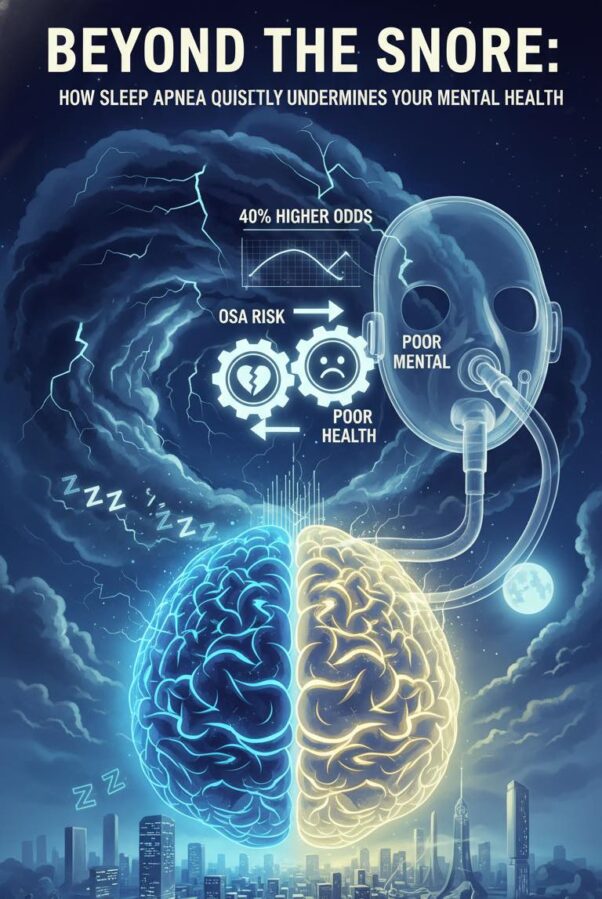
For years, doctors treating obstructive sleep apnea focused on the obvious stuff: snoring, gasping, daytime drowsiness. But a new study suggests they might be missing something equally important. The breathing pauses that define sleep apnea appear to be quietly reshaping patients’ mental health, sometimes long before anyone notices.
Research published in JAMA Network Open found that middle-aged and older adults at high risk for sleep apnea face roughly 40% higher odds of experiencing depression, anxiety, or psychological distress. That’s not just correlation. Among people who started the study mentally healthy, those at high risk for sleep apnea were 20% more likely to develop mental health problems over time.
“The study highlights the urgent need for integrated screening and support for both sleep and mental health,” the researchers wrote, though they stopped short of declaring definitive cause and effect.
A Connection Decades in the Making
The link between sleep and mental health emerged slowly. Before the 1960s, medicine fixated on physical symptoms of sleep apnea, sometimes called Pickwickian syndrome after the rotund boy in Dickens who kept falling asleep. The emotional toll barely registered. Body and mind were treated as separate kingdoms.
That started changing in the 1980s, when early clinical studies noticed something peculiar: a significant percentage of sleep apnea patients also struggled with anxiety or depression. Some studies found correlations between apnea severity and depression scores, though the data remained patchy.
In 1979, Dr. Colin Sullivan invented CPAP therapy, initially focusing on physical benefits like reduced snoring and better oxygen saturation. Early research on its impact on emotional well-being yielded inconsistent results, nobody quite sure what they were measuring or why.
The breakthrough came in the early 2000s. A landmark 2003 Stanford study solidified the association, finding that depressed individuals were five times more likely to have sleep-disordered breathing. That flipped the script: maybe sleep problems weren’t just a symptom. Maybe they were driving the bus.
How Apnea Hijacks the Brain
Sleep apnea attacks mental health through multiple pathways, most of them operating below conscious awareness. Sleep fragmentation comes first. Repeated awakenings, often unnoticed by the sleeper, prevent deep restorative sleep. The result: chronic fatigue, hair-trigger irritability, stress sensitivity cranked to maximum.
Then there’s oxygen deprivation. Each breathing pause starves the brain, a condition called intermittent hypoxia. Over time, this alters crucial areas like the hippocampus, which handles memory formation, and the frontal cortex, which manages emotional control and decision-making. Think of it as a slow-motion stroke, repeated nightly.
The chemistry shifts too. Chronic stress and hypoxia disrupt neurotransmitter balance, potentially depleting serotonin while increasing stress hormones like cortisol. That combination fosters both anxiety and depression, creating fertile ground for mental health problems to take root.
Advanced imaging reveals physical brain changes in sleep apnea patients: alterations in white matter, the brain’s communication network, and disruptions to the glymphatic system, which removes metabolic waste during sleep. When that waste removal system fails, cognitive function and emotional regulation both suffer. The studies show links to anxiety disorders, PTSD, and even increased risks of suicidal ideation.
Evidence indicates that sleep apnea alone can cause early cognitive decline, affecting attention, memory, and executive functions even in otherwise healthy individuals. It acts as what researchers call a “brain drain.” Layer on the common complications like hypertension, cardiovascular disease, and diabetes, and you’ve got a complex web of interconnected factors all pulling cognitive function downward.
The Treatment Puzzle
CPAP machines help, producing modest improvements in mental health, particularly for depression and PTSD. But adherence remains challenging, especially for individuals with co-existing psychological conditions. It’s hard to stick with an uncomfortable therapy when depression has already sapped your motivation.
Future care models are shifting toward integration. That means systematic mental health screening built into sleep evaluations. Research into modifiable factors like chronic pain, respiratory problems, and medication interactions that might worsen mental health in apnea patients. Development of convenient screening tools for cognitive impairment specific to sleep apnea. Personalized treatment plans based on individual cognitive profiles and biomarkers rather than one-size-fits-all approaches.
Some researchers are exploring sleep microstructure, the fine-grained architecture of sleep stages, looking for patterns that predict mental health complications. Others are investigating sex-related differences in how apnea impacts mood and cognition, since the condition manifests differently in women than men.
The message for patients is straightforward: loud snoring, waking up tired despite adequate time in bed, or unexplained mood changes all warrant discussion with a doctor. Early detection and integrated care for both sleep apnea and mental health could mean the difference between managed symptoms and accelerating decline.