Skip to content
ScienceBlog.com
  • Featured Blogs
    • EU Horizon Blog
    • ESA Tracker
    • Experimental Frontiers
    • Josh Mitteldorf’s Aging Matters
    • Dr. Lu Zhang’s Gondwanaland
    • NeuroEdge
    • NIAAA
    • SciChi
    • The Poetry of Science
    • Wild Science
  • Topics
    • Brain & Behavior
    • Earth, Energy & Environment
    • Health
    • Life & Non-humans
    • Physics & Mathematics
    • Social Sciences
    • Space
    • Technology
  • Our Substack
  • Follow Us!
    • Bluesky
    • Threads
    • FaceBook
    • Google News
    • Twitter/X
  • Contribute/Contact

Archaeology

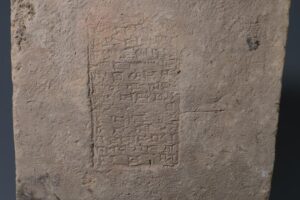
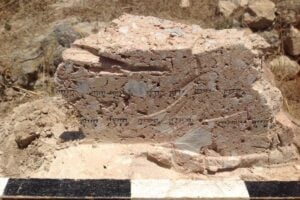
One of the studied burnt mudbricks.

Researchers use earth’s magnetic field to verify Old Testament event

Mesopotamian brick

Mesopotamian bricks unveil the strength of Earth’s ancient magnetic field

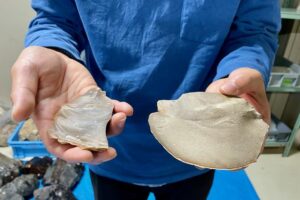
An archaeologist, Eiki Suga, showing fine-grained flint (left) and middle-grained flint (right).

Paleolithic humans may have understood the properties of rocks for making stone tools

Roman fort

Between Sky and Sand

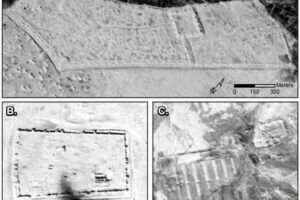
CORONA images showing major sites: A) Sura (NASA1401); B) Resafa (NASA1398); and C) Ain Sinu (CRN999).

Cold War spy satellite imagery reveals Ancient Roman forts

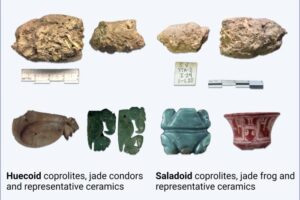
Coprolites and artifacts recovered from the Huecoid and Saladoid archaeological sites.

Mummified poop reveals pre-Columbian cultures ate peanuts, papaya, maize, and even cotton and tobacco

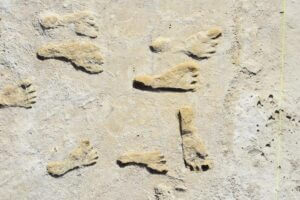
Ancient footprints in New Mexico

Study confirms age of oldest fossil human footprints in North America

Comet in sky

A prehistoric cosmic airburst preceded the advent of agriculture in Middle East

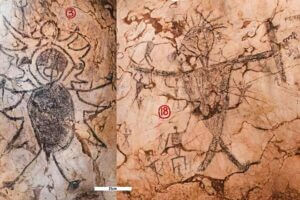
The dated rock art. Image by Andrea Jalandoni

Malaysian rock art found to depict elite–Indigenous conflict

Europe’s ancient languages shed light on a great migration and weather talk

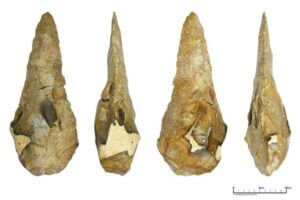
The largest giant handaxe

Giant stone artifacts found on rare Ice Age site in Kent

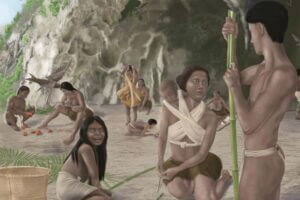
Fiber technology at Tabon Cave, 39-33 000 years ago. An artistic view based on the latest archaeological data. Drawing by Carole Cheval-Art'chéograph. Made for the exhibition "Trajectories and Movements of the Philippine Identity" curated by Hermine Xhauflair and Eunice Averion. Scientific advising: Hermine Xhauflair.

Ancient Stone Tools Reveal Prehistoric Plant Technology

Ham being thinly carved

Oldest Evidence of Cannibalism Identified Among Human Ancestors

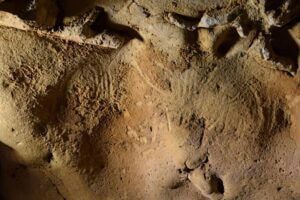
Examples of engravings discovered in the Roche-Cotard cave (Indre et Loire - France). On the left, the "circular panel" (ogive-shaped tracings) and on the right the "wavy panel" (two contiguous tracings forming sinuous lines).

France’s La Roche-Cotard Cave Holds Neanderthals’ Oldest Known Engravings

Older posts
Newer posts
← Previous Page1 Page2 Page3 Page4 Next →
Substack subscription form sign up

Comments

  • Karoly Mirnics on Common Prescription Drugs May Disrupt Cholesterol Pathways in the Womb and Raise Autism Risk
  • Aizen on Laziness helped lead to extinction of Homo erectus
  • Norwood johnson on Electrons in New Crystals Behave as If They Live in Four Dimensions
  • ScienceBlog.com on Hidden Geometry Could Finally Fix Quantum Computers
  • Theo Prinse on America Is Going Back to the Moon. This Time, It Plans to Stay
© 2026 ScienceBlog.com | Follow our RSS / XML feed