Skip to content
ScienceBlog.com
  • Featured Blogs
    • EU Horizon Blog
    • ESA Tracker
    • Experimental Frontiers
    • Josh Mitteldorf’s Aging Matters
    • Dr. Lu Zhang’s Gondwanaland
    • NeuroEdge
    • NIAAA
    • SciChi
    • The Poetry of Science
    • Wild Science
  • Topics
    • Brain & Behavior
    • Earth, Energy & Environment
    • Health
    • Life & Non-humans
    • Physics & Mathematics
    • Social Sciences
    • Space
    • Technology
  • Our Substack
  • Follow Us!
    • Bluesky
    • Threads
    • FaceBook
    • Google News
    • Twitter/X
  • Contribute/Contact

cancer research

Gloved hand holding a specimen dish in a lab

New Hope for Drug-Resistant Prostate Cancer

race car

Killing cancer by making it overheat

Clavelina moluccensis, the bluebell tunicate

Sea Squirt-Derived Drug Shows Promise in Fighting Drug-Resistant Cancers

Illustration of surgeon holding a heart

Hydrogels can help mend a broken heart

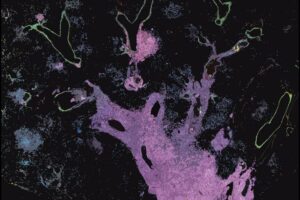
Researchers catch lung cancer transformation in the act: Immunofluorescence image shows small cell lung cancer (purple-pink) spreading throughout the bronchioles (green) of a mouse lung containing residual lung adenocarcinoma tumor cells (blue). CREDIT Dr. Eric Gardner, Varmus Lab

How one type of lung cancer can transform into another

glioblastoma illustration

Early, promising glioblastoma treatment

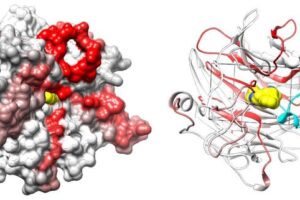
The two proteins side by side

Study uncovers two proteins’ crucial role in causing cancer cell growth

cancer cells illustration

Secondary cancers following CAR T cell therapy are rare

A C57BL/6 mouse used in the study (Photo: Haruka Wada)

Cancer stem cells trigger macrophage aging

Associate Professor Cedric Bardy, SAHMRI & Flinders University, South Australia

Anti-anxiety drug may improve brain cancer survival chances

Ohio State logo

Revealing structural secrets of a key cancer protein

A figure illustrating how a “closed-loop” implant called HAMMR (short for “hybrid advanced molecular manufacturing regulator”) will be used to treat recurrent ovarian cancer. The implant, which is small enough to be implanted with minimally invasive surgery, is being developed by a Rice University-led team of researchers from eight universities and two companies in seven states. The Advanced Research Projects Agency for Health awarded $45 million to fast-track development of the implant, which includes funding for a first-phase clinical trial within five years.

Feds fund research that could slash US cancer deaths by 50%

Young cancer survivors in Europe get increased post-cure help

Shining light on an aggressive brain cancer

Older posts
Newer posts
← Previous Page1 Page2 Page3 Page4 Next →
Substack subscription form sign up

Comments

  • Aizen on Laziness helped lead to extinction of Homo erectus
  • Norwood johnson on Electrons in New Crystals Behave as If They Live in Four Dimensions
  • ScienceBlog.com on Hidden Geometry Could Finally Fix Quantum Computers
  • Theo Prinse on America Is Going Back to the Moon. This Time, It Plans to Stay
  • george w on Hidden Geometry Could Finally Fix Quantum Computers
© 2026 ScienceBlog.com | Follow our RSS / XML feed