

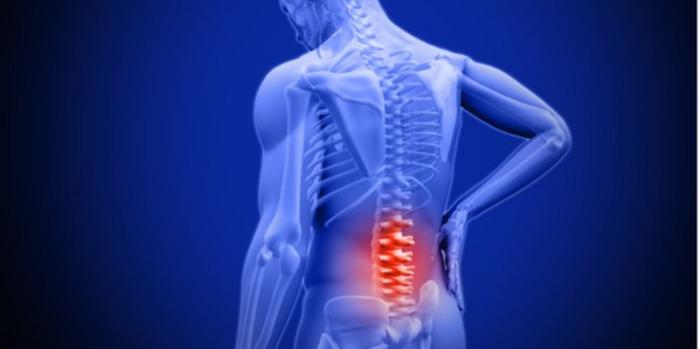
THE MICE WITH lumbar spine instability shouldn’t have been moving much. Their vertebrae, surgically destabilized to mimic the kind of degeneration that afflicts millions of people with chronic back pain, had developed the telltale signs of the condition: porous, sclerotic endplates and an invasion of pain-sensing nerves into tissue where they don’t belong. But after two months of daily hormone injections, they were running on their activity wheels, tolerating pressure on their spines, and withdrawing more slowly from heat. Something had changed in the architecture of their pain.
Parathyroid hormone, PTH to researchers, is already prescribed for osteoporosis, where its bone-building effects are well established. But Janet Crane at Johns Hopkins University in Baltimore and her colleagues suspected it might do more than strengthen skeletons. Their hunch, published last month in Bone Research, reveals a mechanism that could reshape how we think about chronic low back pain: not just as a structural problem, but as a conversation between bones and nerves that’s gone terribly wrong.
Low back pain is staggeringly common, affecting up to 42 percent of people between ages 40 and 69, with annual costs in the US exceeding 100 billion dollars. Yet most of it is classified as “nonspecific”—doctors can’t point to a clear structural cause. Crane’s team focused on one suspect: the vertebral endplate, a thin layer between spinal discs and vertebrae that normally cushions shock. During aging or mechanical stress, these endplates undergo a troubling transformation. They calcify, develop pores, and—critically—become invaded by sensory nerve fibers that have no business being there.
The research tested PTH in three different mouse models: naturally aged mice at 22 months, young mice with surgically induced spinal instability, and SM/J mice with genetic susceptibility to accelerated degeneration. All three groups showed similar patterns of endplate deterioration. All three responded to PTH treatment with measurable improvements.
Micro-CT scans revealed the first changes: PTH-treated mice showed increased bone volume in their endplates, with decreased porosity and pore space. The endplates, essentially, were being rebuilt. But structure alone doesn’t explain pain relief. The team used immunofluorescence to visualize something more subtle—the nerve fibers themselves, marked by proteins called PGP9.5 and CGRP. In treated mice, these aberrant nerve fibers significantly decreased in both the vertebral bodies and endplates. Even more telling, CGRP expression dropped in the dorsal root ganglia, the neural hubs where sensory signals are processed. The nervous system wasn’t just being blocked; it was being rewired.
The mechanism centres on bone cells called osteoblasts, which build new bone tissue. Crane’s team genetically deleted PTH receptors specifically in osteocalcin-expressing cells—a lineage that includes osteoblasts and osteocytes. Without these receptors, PTH lost its power. The endplates stayed porous, the mice stayed hypersensitive, and the aberrant nerve fibers persisted. Osteoblasts, it turned out, were the crucial middlemen.
But what signal were these bone cells sending to the nervous system? The researchers screened genes for repellent guidance factors—molecules that actively push nerve fibers away. Three candidates emerged: Slit3, Sema3a, and EphrinB2. Only Slit3, though, increased significantly in PTH-treated aged mice compared to both vehicle-treated aged mice and young controls. In cultured osteoblast cell lines, PTH increased Slit3 expression in a dose-dependent manner. Further experiments traced this to a transcription factor called FoxA2, which binds to the Slit3 gene promoter and ramps up production when PTH is present. The chain of command was clear: PTH activates osteoblasts, which activate FoxA2, which produces Slit3, which repels invading nerve fibers.
To confirm Slit3’s role, the team used a microfluidic device, essentially, a maze for neurons. They cultured dorsal root ganglion neurons and exposed them to conditioned medium from PTH-treated osteoblasts. Nerve axons grew significantly shorter than in controls. Adding a Slit3 antibody to block the protein’s action reversed this effect: the axons lengthened again. Conversely, adding recombinant Slit3 protein directly mimicked PTH’s nerve-repelling effects. In the final test, mice genetically engineered to lack Slit3 in their osteoblasts showed no response to PTH treatment—no structural improvement, no pain relief, no reduction in nerve fibers.
The findings fit into a larger picture that Crane’s group has been assembling. Previous work showed that osteoclasts, the cells that break down bone, secrete a nerve attractant called Netrin-1, drawing pain fibers into degenerating endplates. PTH treatment appears to restore balance, ramping up the nerve-repelling Slit3 from osteoblasts while rebuilding the porous bone. It’s a two-pronged approach: push the nerves away while fixing the underlying damage.
Some evidence suggests this might work in humans, too. Clinical trials of teriparatide and abaloparatide—synthetic PTH analogues used for osteoporosis—have reported reductions in back pain among patients, though these weren’t the primary endpoints being studied. The effects weren’t universal, and the studies didn’t specifically look at endplate degeneration. But the hints are there.
“During spinal degeneration, pain-sensing nerves grow into regions where they normally do not exist,” Crane explains. “Our findings show that parathyroid hormone can reverse this process by activating natural signals that push these nerves away.” The implications extend beyond mice with surgically altered spines. If the mechanism holds in humans, chronic back pain might be treated not with drugs that numb sensation, but with hormones that fundamentally remodel the relationship between bone and nerve. The vertebral endplate, long overlooked as mere anatomical scaffolding, emerges as an active participant in pain—and potentially, in its relief.
Study link: https://www.nature.com/articles/s41413-025-00488-z