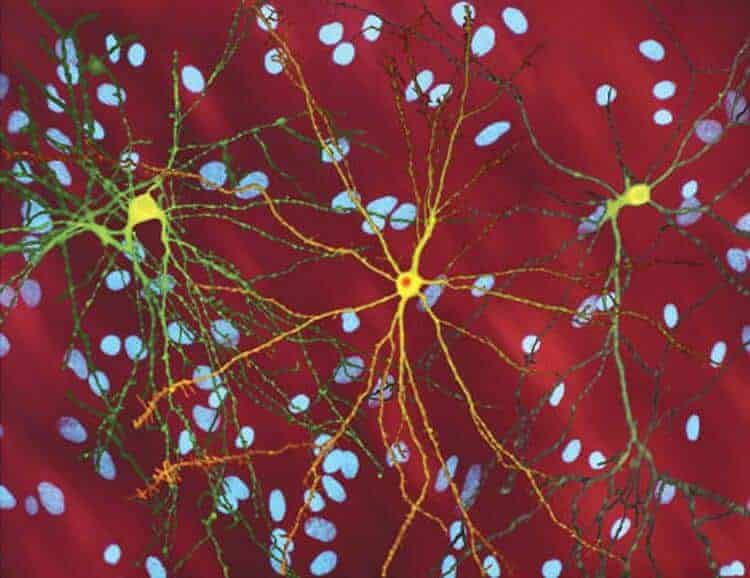
Microscope image of a neuron (yellow) showing a collection of Huntington’s disease proteins collecting at it’s core (orange).
Huntington’s is a devastating genetic disease, described by patients as being like “Parkinson’s, Alzheimer’s and motor neurone disease rolled into one”. In most cases the disorder can be traced back to an inherited genetic mutation which increases the length of the Huntingtin gene. The mutated gene harbours an abnormally long sequence of the DNA base pairs C A and G (this type of mutation is known as a CAG expansion). Sufferers commonly have one normal copy of the Huntingtin gene and one mutant
Bloggers

The science behind the stories: drug treatment to slow progress of Huntington’s disease.
Microscope image of a neuron (yellow) showing a collection of Huntington’s disease proteins collecting at it’s core (orange). Huntington’s is a devastating genetic disease, described by patients as being like…