

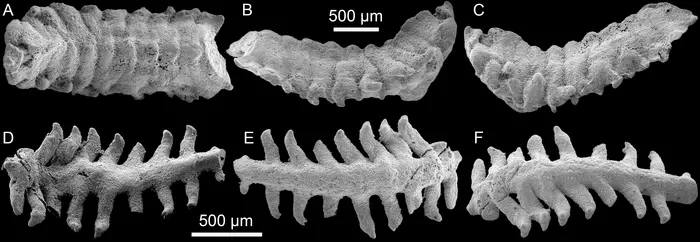
Seven little worms, none more than a few millimeters long, were picked from acid-dissolved rock in southern Shaanxi Province over the course of painstaking residue-hunting. They do not look like much at first glance. Just phosphatic endocasts: the three-dimensional interior moulds of bodies that decayed and left behind a segmented cast preserved in stone. But what those casts record has, with the publication of a new paper in PNAS, extended the fossil history of the ringed worms by roughly 17 million years, and has placed the earliest known swimming annelid deep in the first stages of the Cambrian Period.
Annelids are the phylum of bristle worms, earthworms, leeches and peanut worms. Around 20,000 species are alive today, most of them in the ocean. They decay so readily after death that clear fossil evidence of them is thin on the ground, and almost all of the early evidence that exists has, until now, come from Burgess Shale-type deposits that preserve soft tissue as flattened two-dimensional films. The earliest of those is roughly 518 million years old. The new specimens are about 535 million years old, and three-dimensional.
A Different Preservation Window
Annelid bodies are mostly soft, covered by a collagenous cuticle that simply rots; their hard parts, when they have any, are largely the chaetae and jaws that grip and scrape. That makes three-dimensional preservation in rock an extremely rare event. It is why the new specimens, recovered from the Kuanchuanpu Formation at the Zhangjiagou section in Shaanxi, matter far beyond the handful of fossils found so far. They represent a distinct taphonomic mode, an Orsten-type phosphatised microfossil deposit, and one in which a normally invisible phylum has become visible.
The Kuanchuanpu rock is digested in dilute acetic acid. Microfossils are then plucked from the residue under a binocular microscope. It’s tedious work.
A team led by Huaqiao Zhang at the Nanjing Institute of Geology and Palaeontology, with collaborators at Virginia Tech, LMU Munich and the First Institute of Oceanography, scanned the specimens using micro-CT and a field-emission scanning electron microscope. What emerged was a consistent body plan: an elongated segmented trunk, with each segment carrying a pair of lateral outgrowths, each outgrowth ending unambiguously in a bifid tip made of two terminal lobes. Two morphotypes showed up. One had short, lappet-shaped appendages; the other had appendages longer than the body was wide.
Short Legs and Long Legs
The researchers named the two forms Kuanchuanpivermis brevicruris and Zhangjiagoivermis longicruris, Latin for short-legged and long-legged respectively. Both are interpreted as members of the total-group Annelida, with their lateral outgrowths treated as biramous parapodia and the two terminal lobes as notopodium and neuropodium, the dorsal and ventral branches that still adorn the flanks of a modern polychaete.
Endocasts don’t preserve much. The integument, the chaetae, the prostomium, any fine sensory hairs, all are lost; what the casts do preserve is the rough topology of the interior, the segment count, the orientation of the lateral outgrowths, and the shape of the distal lobes. That turns out to be enough, in context, to rule out a long list of alternatives. These are not algal branches (wrong symmetry, wrong branching pattern). They are not stomach contents (too morphologically consistent across seven specimens). They are not velvet-worm ancestors or tardigrade relatives either: the terminal lobes are too large and too equal-sized to be the retracting claws of a lobopod. That leaves annelids.
Zhangjiagoivermis is the more eye-catching of the two. Its elongate-stemmed appendages, tipped with two roughly equal rounded rami, bear a striking resemblance to the parapodia of Tomopteris, the translucent holopelagic polychaete that paddles through today’s open ocean with metachronal waves of its wing-like limbs. The authors stop short of placing Zhangjiagoivermis in the tomopterid family, noting that the similarity could be convergent evolution toward a swimming lifestyle rather than evidence of deep kinship. But the appendages imply the lifestyle either way. If Zhangjiagoivermis longicruris was propelling itself through water the way Tomopteris does, it is the earliest known swimming annelid in the record, full stop.
Kuanchuanpivermis, with its shorter and more crowded outgrowths, looks more nereid-like: the sort of polychaete that crawls along sediment rather than swimming above it. Both animals were tiny, a few millimeters long, and at that body size the surrounding seawater behaves more like syrup than open ocean. Whatever they did, they did slowly.
What This Means for Animal Evolution
Several consequences follow. Polychaete-style bodies appear to have been primitive among annelids rather than derived from burrowing clitellate ancestors, which matches what phylogenetic analyses of living species have also been suggesting. The group had diversified ecologically, into benthic and pelagic lifestyles, by the Fortunian Age, roughly the first 10 million years of the Cambrian, which is earlier than nearly anyone had previously placed it. And if segmented trunks with biramous parapodia were already in place 535 million years ago, the ancestors of the annelids must have been differentiating well before that. The Cambrian explosion, as the popular framing has it, did not grow this phylum from scratch; it is more accurate to say the Cambrian is where the record finally becomes visible.
What comes next depends on finding more Orsten-type deposits. The Burgess Shale gave the world one fossil window into the early Cambrian. Orsten-type phosphatisation may be opening another, and this one looks into the three-dimensional interior of creatures that spent most of the rest of their time dissolving back into mud.
Frequently Asked Questions
Why is a 535-million-year-old worm fossil a big deal?
Two reasons. The previous oldest convincing ringed-worm fossils were around 518 million years old, so this discovery pushes annelid history back by roughly 17 million years into the earliest stages of the Cambrian Period. And because the new fossils are preserved in three dimensions rather than flattened, they record body features (segmented trunk, paired parapodia, bifid terminal lobes) that flatter preservations tend to smear out. That combination is rare.
How can scientists identify a worm from a fossil the size of a pinhead?
The specimens were studied with scanning electron microscopy and micro-computed tomography, which together allow researchers to examine both surface texture and internal structure at very high resolution. What identifies them as annelids is not a single feature but the combined body plan: a segmented trunk, paired lateral outgrowths arranged bilaterally, and each outgrowth ending in two distinct lobes that match the notopodium-and-neuropodium structure found in living polychaetes. Alternative interpretations, including algae, stomach contents, and lobopod-bearing arthropod ancestors, don’t fit the morphology as well.
Does this change when complex animals first appeared?
It reinforces something that phylogenetic studies of living annelids have already suggested: that the group must have been diversifying before the Cambrian explosion, not inside it. The new fossils do not push back the origin of complex animals as such, but they do say that by the earliest Cambrian the annelids had already split into bottom-dwelling and swimming lifestyles, which implies an even deeper evolutionary history. What the fossils don’t yet tell us is when that ancestry started. Orsten-type deposits older than 535 million years are the next place to look.