
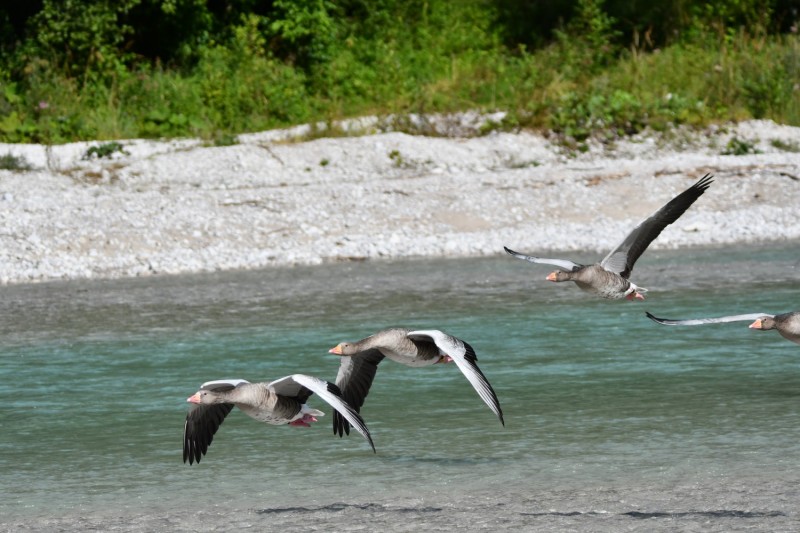
Leadership is not about dominance but about courage and curiosity. A new study from the University of Vienna shows that bold geese, rather than aggressive ones, are more likely to become flock leaders, while exploratory individuals play the role of first followers. Conducted at the Konrad Lorenz Research Station in Austria and published in iScience, the research tracked greylag geese (Anser anser) over four years, revealing that personality traits predict who initiates flight and who responds, reshaping long-standing assumptions about animal influence and collective movement.
Personality Shapes Collective Behavior
The researchers color-banded and observed 117 individually marked geese, recording 742 group departure events. By combining detailed field notes with standardized behavioral assays, they measured three personality traits: boldness (flight initiation distance), aggressiveness (mirror response), and exploration (novel-object interaction). They found that:
- Bolder geese recruited more followers and held higher “influencer scores”.
- Exploratory geese were more likely to be first followers, spreading information and innovation.
- Aggressiveness, despite predicting dominance in other contexts, did not correlate with leadership.
The study demonstrates that stable personality traits persist for years and shape how geese coordinate daily movements to feeding and roosting sites in the Alpine valley.
Bold Protectors and Curious Scouts
Each decision to move carries tradeoffs: safety in familiar grounds versus opportunities in new areas. Bold leaders help manage risk by offering protection, while curious followers aid discovery. This dynamic partnership highlights a protective style of leadership rather than a dominant one.
“This research helps to explain why individuals with specific traits consistently wield more influence,” says lead author Sonia Kleindorfer. “More importantly, it draws attention to followers – often overlooked in our human fascination with securing resources.”
The findings challenge traditional models of leadership focused on aggression and rank. Instead, they underscore the cognitive role of followers in choosing whom to trust, shaping information flow and cultural transmission in goose societies.
Lessons Beyond the Flock
By shifting attention from dominance to decision-making strategies, the work opens new avenues for understanding collective behavior across species, including humans. It suggests that cultural evolution, from migration patterns in birds to group decisions in primates, may depend as much on attentive followers as on charismatic leaders.
For more on the geese, see a video from the Konrad Lorenz Research Station.
Journal: iScience. DOI: 10.1016/j.isci.2025.112345
Discover more from Wild Science
Subscribe to get the latest posts sent to your email.