
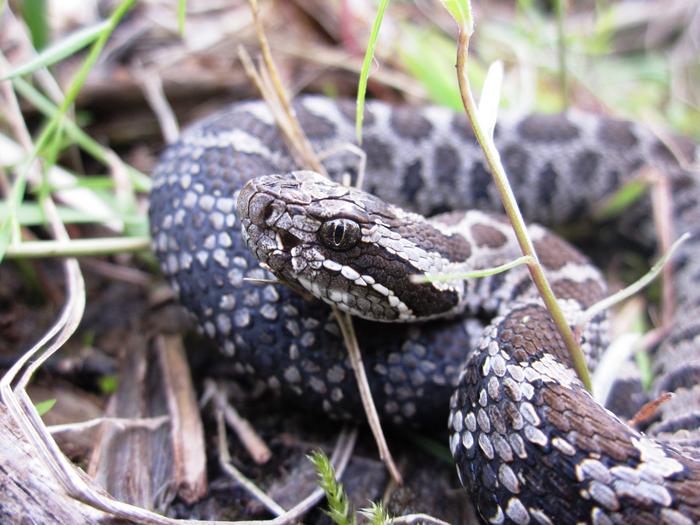
Michigan’s only rattlesnake is quietly losing ground. A new 15-year study shows that inbreeding among Eastern Massasauga rattlesnakes is reducing survival and reproductive success, raising alarm for the federally threatened species.
The research, led by Michigan State University conservation biologists and published in the Proceedings of the National Academy of Sciences, traced family histories of more than 1,000 snakes across two counties to reveal clear evidence of inbreeding depression in the wild.
Fragmentation and Inbreeding
Eastern Massasaugas (Sistrurus catenatus) once roamed wetlands across the Midwest, but habitat loss and human development have fragmented their range. In Michigan, populations are now clustered into small, isolated patches. Because the snakes rarely leave their home wetlands, barriers like roads and farms prevent them from finding mates outside their family groups. This isolation sets the stage for inbreeding, which occurs when closely related individuals reproduce.
Researchers documented that the most inbred snakes were 13 percent less likely to produce surviving offspring and had nearly 12 percent lower annual survival. These findings provide direct evidence of inbreeding depression, a decline in fitness caused by parental relatedness, in free-ranging rattlesnakes.
“The fact that we’re detecting problems from inbreeding in these populations is concerning, given that many other populations throughout the Midwest are much smaller and even more fragmented,” said Sarah Fitzpatrick, senior author of the study and professor at Michigan State University (MSU).
Fifteen Years in the Wetlands
To reach these conclusions, the team carried out one of the longest rattlesnake studies ever conducted. Each summer since 2009 in Cass County and 2011 in Barry County, researchers in hip waders and rubber boots searched wetlands armed with snake tongs. They measured and tagged each captured snake, collected blood samples, and then released them back into the wild.
Over time, these data revealed who lived, who died, and who successfully reproduced. Genomic sequencing allowed the scientists to reconstruct multigenerational family trees, connecting genetic patterns with field observations. The result was a rare view of how inbreeding affects both survival and reproductive output in a threatened species.
Consequences for Conservation
Eastern Massasaugas are not beloved by many people, but they play a vital ecological role. As predators of rodents like mice and rats, they keep populations in check and help maintain the balance of wetland ecosystems. Their disappearance could ripple through food webs and even affect nearby farms and homes.
Lead author Meaghan Clark, a former MSU graduate student, noted that the study provides proof that fragmented populations are vulnerable even when they appear stable. She emphasized that habitat connectivity is essential if Eastern Massasaugas are to persist long-term. In practice, this could mean restoring wetlands, building wildlife underpasses beneath roads, or even relocating individuals to promote genetic mixing.
Key Findings at a Glance
- Study analyzed more than 1,000 snakes over 15 years in Cass and Barry counties, Michigan.
- Most inbred individuals were 13% less likely to produce surviving offspring.
- Annual survival was nearly 12% lower for the most inbred snakes.
- Populations showed fine-scale genetic clustering, linked to limited dispersal.
A Cautionary Tale for Wildlife
The results highlight broader lessons for conservation biology. Inbreeding depression is notoriously hard to detect in wild animals, particularly in elusive and venomous species. Yet by combining genomics with long-term monitoring, the researchers demonstrated that even moderately sized populations can suffer hidden genetic risks.
For Eastern Massasaugas, the stakes are high. The species is federally listed as threatened under the U.S. Endangered Species Act, and many populations outside Michigan are already in sharper decline. Fitzpatrick and colleagues argue that proactive steps to improve connectivity could be the difference between persistence and extinction.
They may inspire fear, but rattlesnakes are vital allies to wetlands. Preserving their genetic health is not just about saving a single species, but about protecting the ecosystems they anchor for future generations.
Journal: Proceedings of the National Academy of Sciences
DOI: 10.1073/pnas.2501745122
Discover more from Wild Science
Subscribe to get the latest posts sent to your email.