
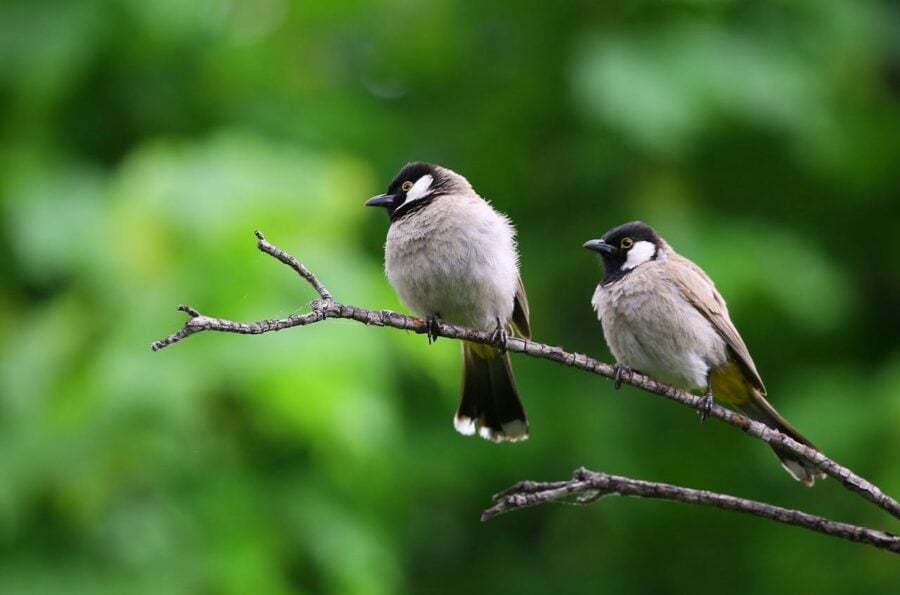
When a reed warbler in Zambia spots a cuckoo near its nest, it lets out a distinctive whining call. Halfway across the world in Australia, a fairy-wren does exactly the same thing. The two species have never met, separated by thousands of miles and 53 million years of evolutionary history. Yet they speak the same language when danger appears.
An international research team has documented what appears to be the first known example of animal communication that straddles the line between pure instinct and learned behavior. More than 20 bird species across four continents produce nearly identical vocalizations when they detect brood parasites (birds that lay eggs in other species’ nests, forcing unwitting hosts to raise their young). The findings, published October 3 in Nature Ecology and Evolution, offer a rare window into how complex communication systems might evolve from simpler roots.
The discovery came from one of the largest studies of brood parasitism to date, involving researchers from Cornell University, Donana Biological Station in Spain, and institutions across multiple continents. What makes the whining call unusual is not just its widespread use, but how birds acquire it.
An Innate Sound With Learned Meaning
When a bird hears the warning call for the first time, something automatic kicks in. The sound triggers an innate response, pulling the bird toward the commotion to investigate. But what happens next is where learning enters the picture. As the bird arrives and sees the parasitic intruder near a nest, it begins connecting the dots between the sound, the context, and the threat.
“It’s then, when birds are absorbing the clues around them, that the bird learns when to produce the sound in the future,” said James Kennerley, postdoctoral fellow at the Cornell Lab of Ornithology and co-lead author of the study.
Think of it as a biological Rosetta Stone. The sound itself appears hardwired into avian brains, but deploying it correctly requires observation and social learning. Birds don’t instinctively know when to produce the call; they figure it out by watching others. The result is a vocalization that occupies middle ground between a dog’s growl (purely instinctive) and a human word (entirely learned).
To test whether the calls function as true warnings across species boundaries, researchers conducted playback experiments on three continents. Birds in Australia, Asia, and Africa all responded to recordings of whining calls from distant species they’d never encountered. The reaction was consistent: upon hearing the alarm, birds rapidly recruited to the area, ready to mob the presumed parasite.
Darwin Was Onto Something
The findings resurrect an old idea from Charles Darwin, who speculated that learned communication systems might have evolved by building on instinctive vocalizations. For decades, scientists have treated animal communication and human language as fundamentally separate phenomena, one rooted in biology and the other in culture. This study suggests the boundary may be more porous than previously thought.
“The fascinating thing about this call is that it represents a midpoint between the instinctive vocalizations we often see in animals and fully learned vocal units like human words,” said William Feeney, evolutionary ecologist at Donana Biological Station and co-lead author.
The research also revealed patterns in where the whining call appears. Species that produce it tend to live in ecological hotspots with dense networks of brood parasites and multiple host species. In these pressure-cooker environments, cooperation between different bird species becomes valuable. A reed warbler’s alarm can benefit not just other reed warblers, but also nearby species facing the same parasitic threat.
Kennerley noted that the vocalization is “affecting patterns of cooperative behaviors between birds around the world.” In regions where brood parasitism is less common or involves fewer interacting species, the whining call is correspondingly rare.
The mechanism underlying the innate response to the whining sound remains unclear. One possibility is that the acoustic structure of the call (its frequency, rhythm, and tonal quality) taps into pre-existing neural circuits that flag urgent or threatening situations. Once that automatic alarm is triggered, social learning takes over to refine when and how the vocalization gets used.
For language scientists, the implications extend beyond ornithology. If complex, referential communication can emerge from simpler building blocks through evolutionary processes, it offers a plausible pathway for how human language might have originated. We may be looking at a living example of a transitional form, something that bridges the gap between instinct and culture.
The researchers acknowledge that questions remain. How exactly do young birds learn to associate the whining call with brood parasites? Does the learning process vary between species? And are there other examples of this hybrid communication strategy waiting to be discovered in the animal kingdom?
What’s certain is that the next time you hear birds making a fuss, they might be doing more than just reacting. They could be teaching each other a vocabulary that’s been millions of years in the making.
Nature Ecology & Evolution: 10.1038/s41559-025-02855-9
Discover more from Wild Science
Subscribe to get the latest posts sent to your email.