

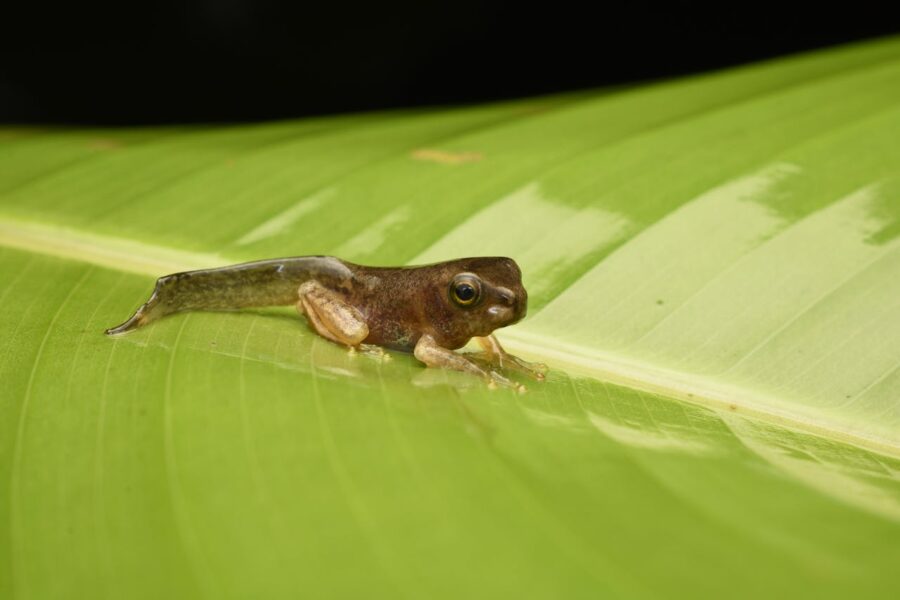
Scientists have stumbled onto a strange quirk of evolution: tadpoles that lose their lungs through evolutionary time never regrow them, even when returning to environments where lungs would be useful. The finding challenges a core assumption about how evolution works, namely that traits with intact genetic blueprints can easily reemerge when conditions change.
All adult frogs have lungs. Their tadpoles, however, tell a different story. Typical tadpoles breathe in three ways: through lungs (from air), through gills (from water), and through their skin (also from air). But 95 known species skip the lung phase entirely as larvae, even though the developmental machinery to build lungs remains tucked in their DNA.
Jackson Phillips, a doctoral student at Cornell University, analyzed 530 frog species spanning nearly every known frog family. He found 28 separate instances where tadpole lungs vanished over evolutionary time. What surprised him most was not the losses themselves, but what happened next: nothing. Once gone, lungs never came back, even when tadpoles later evolved to inhabit environments where breathing air would have been advantageous.
Life Without a Life Raft
The pattern of lung loss follows environmental logic, at least initially. Stream tadpoles, for instance, often lose their lungs because the rushing water already contains plenty of oxygen. Lungs also create buoyancy, turning tadpoles into unwilling rafts.
“If a tadpole is in a fast-flowing stream, it may not want a life raft in its body.”
Phillips and his team traced these losses backward through evolutionary time using genetic relationships and computer models. They found lungless tadpoles clustering in specific habitats: clinging to rocks with sucker mouths in rapids, burrowing in sand and gravel, or developing in terrestrial nests near wet spray zones. Pond-dwelling tadpoles, oddly enough, rarely lost their lungs despite ponds being the most common frog nursery.
The researchers suspect survival pressures beyond simple oxygen access drive lung loss. Floating to the surface exposes tadpoles to predators. Moving from hiding spots to gulp air wastes energy. In some cases, the danger is not having lungs but using them.
“Maybe the adaptation is due to selection against air breathing instead of selection against lungs.”
The One-Way Street of Evolution
Here is where evolutionary theory hits a snag. When tadpoles metamorphose into frogs, they develop functional lungs regardless of whether they had them as larvae. The genetic instructions persist, generation after generation. Standard thinking suggests that retained developmental pathways should make trait recovery relatively easy. Phillips expected to find at least a few cases where lungless tadpole lineages regained their larval lungs when colonizing new habitats.
He found zero.
The study, published October 27 in the journal Evolution, highlights what Molly Womack, Phillips’ advisor and an assistant professor at Cornell, calls the paradox of evolutionary predictability. Lung loss happens repeatedly under similar conditions, following recognizable patterns. But the solutions evolution crafts to replace lost lungs defy prediction entirely. Some tadpoles boost skin breathing. Others rely more heavily on gills. Each lineage improvises its own workaround rather than resurrecting the ancestral lung design.
This irreversibility puzzles evolutionary biologists because it does not fit traditional explanations. Usually, complex traits become irreversible when the genes controlling them accumulate mutations or get repurposed for other functions. But lungless tadpoles retain perfectly functional lung genes, they just do not use them until adulthood. Something else, still unclear, prevents evolutionary U-turns.
The research raises broader questions about constraints on evolution. If a trait can be lost 28 separate times but never regained under any circumstances, what does that say about evolutionary flexibility? Phillips suggests the answer may lie not in genetics but in the survival risks associated with the behavior of air breathing itself. Once natural selection favors tadpoles that avoid the surface, any mutation that brings back lungs might be lethal regardless of whether the organ functions properly.
For now, lungless tadpoles remain evolutionary one-hit wonders: a solution that works well enough that nature keeps inventing it, but never well enough to reverse.