
At a picnic table, the air shimmers with summer heat. You wave your hand at a faint buzz, but it is too late. A mosquito, guided by invisible plumes of carbon dioxide from your breath, has found you. New research from the University of California San Diego reveals in exquisite detail how this tiny hunter does it, exposing intricate structures inside its carbon dioxide-sensing neurons that help it track human hosts.
Mapping the Mosquito’s Molecular Radar
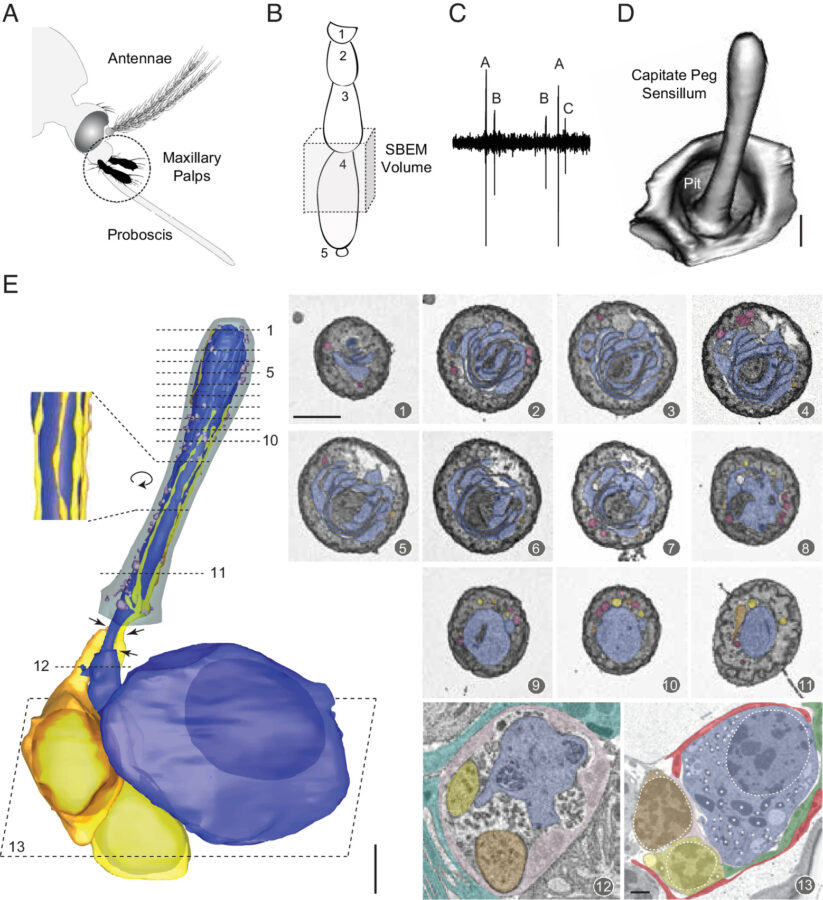
The study, published in the Proceedings of the National Academy of Sciences, uses serial block-face electron microscopy to visualize the mosquito’s carbon dioxide-detecting system in three dimensions. The UC San Diego team, led by neurobiologist Chih-Ying Su, reconstructed nanoscale models of the neurons responsible for sensing CO2 in Aedes aegypti, the same species that spreads dengue, Zika, and yellow fever.
Within the mosquito’s sensory hairs, or sensilla, the researchers discovered specialized olfactory receptor neurons known as cpA. These neurons are distinctively large and exhibit extraordinary surface complexity. The dendrites, or signal-receiving branches, fold into flattened lamellae that expand their sensing area by as much as twelve times compared to neighboring odor-sensitive neurons. Such intricate folding likely amplifies the mosquito’s ability to detect the faintest trace of human breath across long distances.
“Now we have a realistic 3D morphological model that provides quantitative measurements of the sensory surface area,” said Su. “This is the first time we’re seeing this level of detail.”
The team also found that cpA neurons feature axons packed with mitochondria, the cell’s energy producers, forming a distinctive pearls-on-a-string pattern. This unusual configuration may power rapid firing and high metabolic activity, helping mosquitoes react instantly when they sense carbon dioxide. The axons lacked synaptic vesicles, suggesting their mitochondria serve not communication but endurance, fueling a neuron that must stay alert as the insect prowls for prey.
Evolution’s Precision Engineering
The researchers compared their 3D reconstructions to similar neurons in fruit flies, which use CO2 as a danger signal rather than a meal cue. The contrast was striking. Fruit fly neurons were smaller and less complex, with limited surface area for detection. Mosquito cpA neurons, by contrast, are optimized to maximize sensitivity, even at the cost of energy efficiency.
Further analysis revealed that these neurons sit closer to the cuticle, the insect’s outer surface, allowing a larger portion of their dendritic structure to be exposed to the environment. This subtle anatomical shift likely improves the mosquito’s access to carbon dioxide molecules drifting through the air. The surrounding support cells also form a kind of sheath, insulating the neuron and maintaining its delicate ion balance. Even the glial cells show species-specific adaptations, creating what the authors describe as a microenvironment tailored for heightened alertness.
Seen under the microscope, the internal landscape resembles a coral reef of folded membranes and fine connections, every contour serving a purpose. It is a machine built by evolution to read our exhalations and home in with deadly precision.
“For mosquitoes, carbon dioxide is an arousal cue that helps them find us,” said Su. “It’s a trigger for their whole host-seeking behavior.”
Beyond curiosity, this work offers practical insight for public health. Understanding these structural adaptations could guide efforts to disrupt mosquito host-seeking at its sensory root—potentially leading to repellents or genetic interventions that interfere with their ability to detect carbon dioxide. For now, the mosquito’s evolved radar remains one of nature’s most finely tuned instruments of pursuit.
Proceedings of the National Academy of Sciences: 10.1073/pnas.2514666122
Discover more from Wild Science
Subscribe to get the latest posts sent to your email.