Skip to content
ScienceBlog.com
  • Featured Blogs
    • EU Horizon Blog
    • ESA Tracker
    • Experimental Frontiers
    • Josh Mitteldorf’s Aging Matters
    • Dr. Lu Zhang’s Gondwanaland
    • NeuroEdge
    • NIAAA
    • SciChi
    • The Poetry of Science
    • Wild Science
  • Topics
    • Brain & Behavior
    • Earth, Energy & Environment
    • Health
    • Life & Non-humans
    • Physics & Mathematics
    • Social Sciences
    • Space
    • Technology
  • Our Substack
  • Follow Us!
    • Bluesky
    • Threads
    • FaceBook
    • Google News
    • Twitter/X
  • Contribute/Contact

Penn State

In a new study, researchers from Penn State and NASA’s Jet Propulsion Laboratory analyzed human deep space communications and found that human transmissions are frequently directed toward our own spacecrafts near Mars (lower left), the Sun, and other planets. Because planets like Mars do not block the entire signal, an extraterrestrial intelligence positioned along the path of interplanetary communications—when the planets align form their perspective—could potentially detect the spillover. This suggests that humans should look to planetary alignments outside of the solar system when searching for signatures of extraterrestrial communications.

If Aliens Use Space Networks Like Us, We Know Where to Look

mushroom cloud

What Happens to Our Food If the Bombs Drop?

Pistachio nuts isolated on white background

Evening Pistachios Shift Gut Bacteria in People with Prediabetes

Stone alignments revealed an ancient temple, called Palaspata after the native name for the area. The temple complex is approximately 125 meters long by 145 meters wide — about the size of a city block — and includes 15 quadrangular enclosures arranged around a rectangular inner courtyard. This is a digital reconstruction of the temple.

Ancient Temple in Bolivia Sheds Light on Lost Society

A female (left) and male (right) robot

Robot Gender Influences Customer Choices in Restaurants

A new model upends the decades-old “hard steps” theory that intelligent life was an incredibly improbable event and suggests that maybe it wasn't all that hard or improbable. The team of researchers said the new interpretation of humanity’s origin increases the probability of intelligent life elsewhere in the universe.

Study ups odds we’re not alone out there

A native bee sits on a purple flower on the left, while a honey bee sits on a yellow flower on the right.

Native bee populations can bounce back after honey bees move out

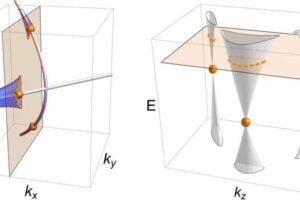
Particle that only has mass when moving in one direction observed for first time

Particle that only has mass when moving in one direction observed for first time

Mature woman crossing the street

Simple Daily Activities May Make Your Brain Four Years Younger

city scene during rain

Microplastics in the Sky: How Tiny Plastic Particles May Be Reshaping Our Weather

Gasto Lyakurwa, doctoral student in recreation, park, and tourism, management at Penn State, walks through land adjacent to Mkomazi National Park in Tanzania as he conducts research Credit: Provided by Gasto Lyakurwa. All Rights Reserved.

Study Reveals Food Insecurity Drives Poaching in Tanzania’s National Parks

Australian couple hugging

Australia’s Success in Life Expectancy

Painting of a young woman sleeping

Study Links Childhood Sleep Patterns to Future Substance Use

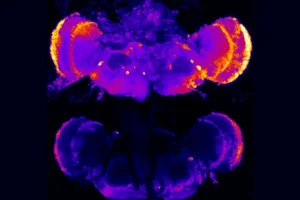
Mutations in the presenilin gene, PSEN1, causes early onset of Alzheimer’s disease in humans and in fruit flies modified to have this gene. A new study led by researchers at Penn State revels that disrupting heparan sulfate–modified proteins in fruit flies suppressed neuronal death and corrected other cell deficits common in early stages of Alzheimer’s and other neurodegenerative diseases. Pictured here are full fruit fly brains, stained with a marker that indicates cell death—brighter colors indicate higher presence of cell death. Top: A fly with deficits in the presenilin gene—a model for Alzheimer’s disease—with high levels of cell death. Bottom: A fly rescued by disrupting heparan sulfate–modified proteins.

Potential new target for early treatment of Alzheimer’s disease

Older posts
Page1 Page2 … Page27 Next →
Substack subscription form sign up

Comments

  • Not Buying Yer Bullshit on More Than a Third of Americans Have Lost Relationships Over Politics
  • Marco Messina on More Than a Third of Americans Have Lost Relationships Over Politics
  • Anon on Why Fructose Behaves Less Like a Calorie and More Like a Hormone
  • Mark Mellinger on Living Plastic Can Self-Destruct on Command
  • Marie Feret on The Silent Frequency That Makes Old Buildings Feel Haunted
© 2026 ScienceBlog.com | Follow our RSS / XML feed