

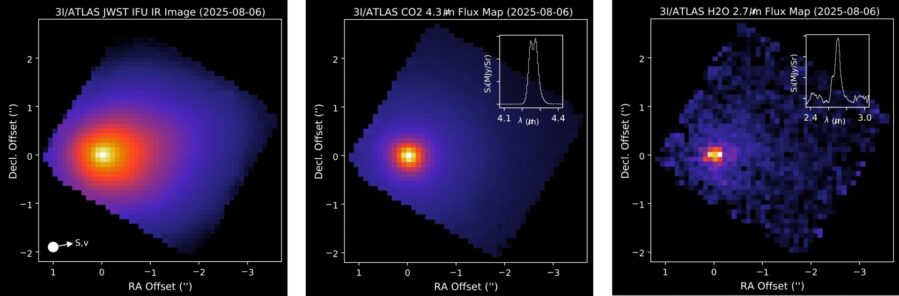
A visitor from deep space carries a chemical twist. On August 6, 2025, NASA’s James Webb Space Telescope (JWST) turned its infrared spectrograph toward comet 3I/ATLAS, only the third confirmed interstellar object ever seen. The early results, posted as a preprint, show a coma dominated by carbon dioxide, and one of the highest CO2-to-water ratios ever measured. Unlike the mostly water-fed comets of our Solar System, this one seems built on carbon, hinting at a birthplace under very different cosmic conditions.
A Strange Messenger
3I/ATLAS was first picked up in July by the ATLAS survey in Hawaii. Its hyperbolic orbit leaves no doubt: this comet is passing through, not circling back. Traveling nearly 58 kilometers per second, it may have been wandering the Galaxy for billions of years, likely born in the Milky Way’s older, metal-poor thick disk. The comet is small, no more than 2.8 kilometers across, but it carries a bright halo of gas and dust.
Webb’s Chemical Snapshot
JWST’s Near-Infrared Spectrograph captured a full spectrum of the comet’s coma, from 0.6 to 5.3 microns. The standout feature was carbon dioxide gas, peaking far above expectations. The CO2-to-H2O ratio came in at 8 ± 1, more than six standard deviations higher than the trend seen in Solar System comets at similar distances.
“Our observations are compatible with an intrinsically CO2-rich nucleus, which may indicate that 3I/ATLAS formed close to the CO2 ice line in its parent protoplanetary disk,” wrote lead author Martin Cordiner of NASA’s Goddard Space Flight Center.
Webb also spotted carbon monoxide, a faint trickle of water vapor, traces of OCS, and icy grains mixed into the dust. Together, they suggest an active, carbon-driven comet where CO2, not water, is doing the heavy lifting.
Why It Doesn’t Fit the Mold
Most comets near 3 to 4 astronomical units are water-dominated, with CO2 and CO playing supporting roles. Not here. One explanation is that 3I/ATLAS was forged in a part of its home disk especially rich in frozen carbon dioxide. Another is that billions of years of radiation in interstellar space have altered its surface, creating a crust that keeps water locked in while CO2 escapes more easily. Similar ideas have been floated for 1I/’Oumuamua, which baffled astronomers in 2017.
Key Findings
- Object: Interstellar comet 3I/ATLAS, found July 2025 by ATLAS survey.
- Observation date: August 6, 2025, with JWST NIRSpec.
- Exposure: 640 seconds of infrared spectra, 0.6–5.3 μm.
- Main discovery: CO2-to-H2O ratio of 8 ± 1, far higher than Solar System norms.
- Other gases and ices: Carbon monoxide, OCS, water ice grains, dust coma.
- Nucleus size: < 2.8 km radius.
- Speed/age: ~58 km/s, 3–11 billion years old.
What Comes Next
The comet is still inbound. As it nears the Sun, more volatiles — especially water — should sublimate. NASA’s Hubble Space Telescope and the new SPHEREx mission will join Webb in watching how its chemistry shifts. Those later observations could confirm whether the comet is truly carbon-loaded or if hidden water ice only wakes up closer in.
Takeaway
Webb has shown that comet 3I/ATLAS is unusually rich in carbon dioxide, unlike the water-fed comets we know best. The finding suggests this alien traveler formed under very different conditions, offering a rare sample of planetary chemistry from beyond our Sun. More surprises may come as it swings inward and its hidden ices start to stir.
Journal: Submitted to Astrophysical Journal Letters, August 25, 2025.
DOI: 10.48550/arXiv.2508.02777</p