

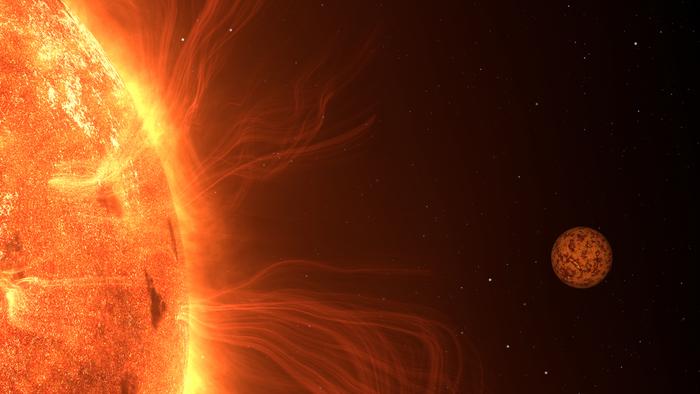
Right now, trillions of particles are passing through your body without leaving a trace. They slip through flesh, bone, and the entire planet as if none of it exists. These are neutrinos, often called ghost particles because they interact with matter so rarely that detecting even one requires detectors the size of buildings buried deep underground.
We’ve known the Sun bombards us with these particles, but the rest of the Milky Way has remained largely invisible. Until now. Researchers at the University of Copenhagen have created the first comprehensive map of stellar neutrinos across the entire galaxy, revealing exactly which stars produce them, where they originate, and how many reach Earth. Published in Physical Review D, the work transforms what was once educated guesswork into a precise, galaxy-wide picture.
Stars as Neutrino Factories
Neutrinos are born during nuclear reactions deep inside stars and during violent cosmic events like supernovae. Unlike light, which bounces through layers of stellar atmosphere before escaping, neutrinos fly straight out from the core. Think of them as postcards mailed directly from a star’s interior while light arrives after a long, chaotic journey through the outer layers.
To build their map, the team combined stellar evolution models with data from the European Space Agency’s Gaia telescope, which tracks the positions and properties of stars across the Milky Way. They simulated everything from tiny red dwarfs to giants more than 100 times the Sun’s mass, following each through its life cycle and calculating its neutrino output.
The results show that most stellar neutrinos reaching Earth don’t come from nearby stars. Instead, they originate thousands of light-years away in dense regions near the galactic center. Massive stars, particularly those as heavy as or heavier than the Sun, dominate the signal. Younger, heavier stars are especially prolific, pumping out neutrinos across a wide energy range shaped by both thermal processes and nuclear reactions.
“For the first time, we have a concrete estimate of how many of these particles reach Earth, where in the galaxy they come from, and how their energy is distributed,” Pablo Martínez-Miravé, the study’s lead author, explains.
The finding matters because neutrinos carry information light cannot. Since they escape stellar cores directly, they reveal what’s happening in regions completely hidden from telescopes. Neutrinos have already confirmed theories about the Sun’s interior. The hope is that with better detection and this new galactic model, they could eventually reveal how stars live and die across the entire Milky Way.
Where to Look Next
Detecting neutrinos remains extraordinarily difficult. The particles pass through detectors just as easily as they pass through everything else. Experiments rely on enormous instruments, often embedded in Antarctic ice or deep underground, waiting for the rare moment when a neutrino collides with an atom.
The new map gives these observatories something they’ve lacked: a roadmap. By focusing on the galactic center, where the signal is strongest, detectors have a much better chance of capturing neutrinos against the constant background noise from the Sun and distant supernovae.
There’s a practical challenge, though. Our Sun’s neutrino output is so intense it often drowns out the faint galactic signal. The researchers suggest future observatories could use Earth’s orbital timing and the direction of incoming particles to filter out solar noise and isolate the Milky Way’s contribution.
Beyond improving detection rates, the map could reveal new physics. Because neutrinos travel across the galaxy almost untouched, scientists have clear expectations for how they should behave. Any deviation, even a tiny one, could point to unknown physical laws.
“Because neutrinos are barely affected, we have clear expectations of how they should behave on their long journey to Earth,” said Irene Tamborra, a professor at the Niels Bohr Institute and senior author of the study. “So even tiny deviations in their behaviour would be a strong clue to new, unknown physics.”
For now, the map does something more immediate. It changes how we see the galaxy around us. The Milky Way isn’t silent or dark. It’s alive with a steady, invisible rain of particles passing through Earth every moment, carrying stories from stars we will never see.