

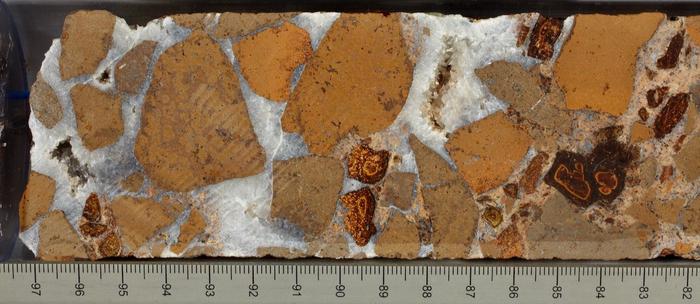
On the floor of the South Atlantic, a 61 million year old pile of broken lava is quietly drinking carbon from the sea. In a study published in Nature Geoscience, a team led by the University of Southampton shows that rubble left behind by collapsing seafloor mountains can lock away seawater derived carbon dioxide for tens of millions of years. The work, based on cores drilled through ancient lava talus at International Ocean Discovery Program Site U1557, points to a previously undercounted carbon sink in Earth’s long term geological carbon cycle.
The cores themselves look unassuming at first glance: dark volcanic breccia shot through with white calcium carbonate, lifted from hundreds of meters beneath the seabed in the South Atlantic Transect drilling campaign. Each section captures fragments of pillow basalt and altered glass that tumbled down fault scarps 61 million years ago, forming a loose talus pile. As the tectonic plates spread, that rubble was slowly rafted away from the Mid Atlantic Ridge, still riddled with open pore spaces where seawater could circulate.
Ancient rubble on the South Atlantic seafloor
For Dr Rosalind Coggon, Royal Society Research Fellow at Southampton and lead author on the paper, the starting point is the volcanic pavement that underlies most of the world’s oceans. “The oceans are paved with volcanic rocks that form at mid-ocean ridges, as the tectonic plates move apart creating new ocean crust. This volcanic activity releases CO₂ from deep inside the Earth into the ocean and atmosphere,” she explained in the university release. The usual picture is simple: volcanoes at the ridge add carbon to the system, later reactions between rock and seawater take some of it back.
The new cores complicate that picture in a useful way. At Site U1557, instead of intact lava flows at the top of the crust, the drill encountered a thick talus breccia made of centimeter scale basalt fragments. When the team reconstructed the original structure of the deposit, they found porosities between about 12 and 42 percent by volume, with an average greater than 19 percent. That is a lot of connected void space for seawater to move through and for new minerals to grow in.
Over roughly 40 million years, that empty space did not stay empty. Circulating seawater left behind sparry calcite cement with a distinctive dog toothed habit, fine volcanic material, zeolite carbonate mixtures and, near the top, pelagic sediment packed with microfossils. The researchers measured carbon concentrations in each carbonate bearing component and combined those values with estimates of their volume and density. The result is striking: the talus breccia holds on average about 7.5 weight percent seawater derived CO2, with individual cores ranging from 4.9 to 14.1 weight percent.
“Excitingly, the cores revealed that these porous, permeable deposits have the capacity to store large volumes of seawater CO2 as they are gradually cemented by calcium carbonate minerals that form from seawater as it flows through them.”
Those numbers matter because they sit well above values measured in previously cored sections of upper ocean crust, which typically contain 0.2 to 4.2 weight percent CO2. In other words, this particular rubble pile holds between 2 and 40 times more carbon per unit rock than intact basalt from similar depths. And it does so in a part of the crust that is not normally counted when scientists estimate how much carbon ridge flanks can soak up over time.
The team then moved from one site to the larger system. Using observations of fault geometries and talus wedges from slow spreading segments of the Mid Atlantic Ridge, along with models of how much faulting contributes to plate divergence, they estimated how thick talus deposits like U1557’s might be on average per square kilometer of crust. Combining those thickness estimates with the measured 7.5 weight percent CO2 suggests that talus breccias on slow spreading ridges alone could host a carbon sink comparable to a substantial fraction of the CO2 released when the underlying crust first formed.
There is a time dimension to this sink as well. Strontium isotopes in the carbonate cements show that some of the calcite formed at least 42 million years after the crust was created, long after the original volcanism ended. Oxygen isotopes indicate that the fluids were relatively cool, less than about 15 degrees Celsius, consistent with low temperature hydrothermal circulation on the ridge flanks rather than the short lived, high temperature systems right at the ridge axis. The talus breccia essentially stayed connected to the ocean for tens of millions of years, long enough to keep taking up carbon as seawater percolated through.
That long lived exchange depends on tectonic architecture. At slow spreading ridges, a significant share of plate divergence is taken up by normal faulting, which carves out deep axial valleys and steep scarps. Those faults generate the basaltic talus in the first place and leave behind rough basement topography that is never fully buried by sediment, even after tens of millions of years. The roughness keeps pathways open for seawater to move in and out of the upper crust. Faster spreading ridges, with smoother basement and thicker sediment cover, are less likely to build the same kind of thick, porous talus wedges or to preserve open circulation for as long.
The authors are careful not to claim that one South Atlantic site can rewrite the entire climate history of the planet. The global abundance of talus breccias, especially at intermediate and fast spreading ridges, is still poorly constrained, and key parameters such as average breccia thickness and carbonate content remain uncertain away from the limited areas that have been drilled and imaged. But the study shows that any attempt to balance mid ocean ridge CO2 outgassing against seafloor carbon uptake has been missing a major class of rocks that are very good at holding on to carbon.
For now, the picture is this: volcanic outgassing at mid ocean ridges sends carbon from Earth’s interior into the ocean and atmosphere, and rough, fault scarred ridge flanks quietly take some of it back into solid form. The talus breccias at Site U1557 turn out to be especially effective at that job, acting as geological sponges that store seawater CO2 in carbonate minerals for tens of millions of years. How much that process has buffered past climate swings will depend on just how common these rubble piles are along the world’s ridges, a question that future drilling and geophysical surveys will have to answer.
Journal: Nature Geoscience. Article: “A geological carbon cycle sink hosted by ocean crust talus breccias.” DOI: 10.1038/s41561-025-01839-5.