

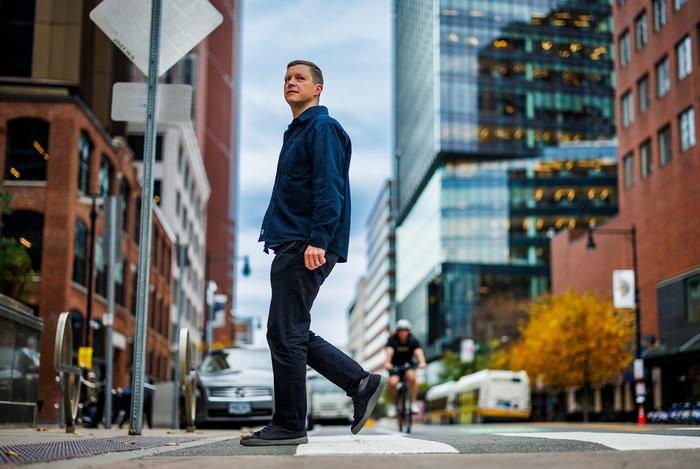
WHERE cars go, cities have always measured. Federal highway funds flow to states based partly on vehicle miles traveled. Traffic counters click away on arterial routes. Every proposed development triggers a vehicle impact study. But pedestrians? They’ve been walking through cities largely uncounted, their movements a mystery even though they outnumber drivers in places like Manhattan.
That’s changing. Researchers at MIT have built the first complete model of foot traffic for any American city: a digital map showing where roughly 8.3 million New Yorkers walk during morning commutes, lunchtime errands, and evening social hours. The work reveals something planners suspected but couldn’t prove: Manhattan’s outer boroughs are full of sidewalks as crowded as many in Manhattan, yet they’re systematically underfunded for pedestrian infrastructure.
“We now have a first view of foot traffic all over New York City and can check planning decisions against it,” says Andres Sevtsuk, an associate professor in MIT’s Department of Urban Studies and Planning who led the study. The model estimates pedestrian volumes on each of the city’s 315,577 sidewalk segments, crosswalks, and footpaths during three peak periods throughout the day.
Midtown Manhattan dominates, unsurprisingly. About 1,697 pedestrians traverse each sidewalk segment per hour during the evening rush; more than twice the density anywhere else. The Financial District comes second at 740 per hour, with Greenwich Village third at 656.
But look beyond Manhattan and the picture gets interesting. University Heights in the Bronx sees 263 pedestrians per hour. Brooklyn’s Borough Park averages 236. The Grand Concourse in the Bronx hits the same figure. Corona in Queens reaches 222. All above 200, solidly busy by most standards, yet these neighborhoods don’t get infrastructure investment that matches their foot traffic.
“Midtown Manhattan has by far the most foot traffic, but we found there is a probably unintentional Manhattan bias when it comes to policies that support pedestrian infrastructure,” Sevtsuk says. “There are a whole lot of streets in New York with very high pedestrian volumes outside of Manhattan… and we’re able to show, based on data, that a lot of these streets have foot-traffic levels similar to many parts of Manhattan.”
The research team (which includes Rounaq Basu from Georgia Tech and several MIT colleagues) spent roughly six months cleaning New York’s sidewalk data, correcting errors and filling gaps where park footpaths weren’t mapped. They calibrated their model using pedestrian counts NYC’s Department of Transportation conducted in 2018 and 2019; about a thousand weekday locations, fewer on weekends. The model then estimated volumes everywhere else by routing ten types of walking trips through the network: homes to jobs, homes to transit stations, jobs to amenities, amenities to amenities, and so on.
Morning patterns are dominated by commuting, which makes sense. “Because of jobs, transit stops are the biggest generators of foot traffic in the morning peak,” says Liu Liu, a PhD student at MIT’s City Form Lab. But evenings? More varied. People still head home from work, but they’re also meeting friends, running errands, picking up kids. “More social and recreational travel happens after work… and that’s what the model detects too,” Liu notes.
The team used their foot-traffic estimates to re-examine NYC’s official street classifications. The city’s Pedestrian Mobility Plan designates corridors as Global, Regional, Neighborhood, Community, or Baseline depending on expected pedestrian volumes. These categories guide infrastructure investment: wider sidewalks, better lighting, fewer obstructions. But the MIT analysis found thousands of street segments that seem miscategorized. Some 2,901 Baseline corridors have pedestrian volumes exceeding typical Neighborhood corridors. Another 684 Community Connectors should probably rank higher.
Take 31st Street at 23rd Avenue in Queens, near the Astoria-Ditmars Boulevard subway station. Evening peak volumes there (over a thousand people per hour) align with what the city calls Global Corridors. Yet the street’s classified as Baseline or Community. The sidewalks meet the 15-foot standard for Neighborhood corridors, but adjacent segments with similarly high volumes remain underclassified.
Safety analysis revealed another pattern. Times Square racks up pedestrian injuries in absolute terms; it’s always near the top of crash count lists. But divide injuries by foot traffic and it’s actually relatively safe. “Places like Times Square and Herald Square in Manhattan may have numerous crashes, but they have very high pedestrian volumes, and it’s actually relatively safe to walk there,” says Basu. The real danger zones? Highway off-ramps, car-heavy infrastructure, even parts of low-density Staten Island. “There are other parts of the city… which turn out to have a disproportionate number of crashes per pedestrian.”
New York isn’t alone in neglecting pedestrian measurement. Los Angeles is working with the MIT team to model foot traffic ahead of the 2028 Olympics. The state of Maine wants analysis for 140 of its cities and towns. Sevtsuk reckons (perhaps optimistically) that the relatively modest data requirements could make this class of model easier to build than traditional vehicle-focused travel demand models.
“I hope this can inspire other cities to invest in modeling foot traffic and mapping pedestrian infrastructure as well,” Sevtsuk says. “Very few cities make plans for pedestrian mobility or examine rigorously how future developments will impact foot-traffic. But they can.”
Study link: https://www.nature.com/articles/s44284-025-00383-y