

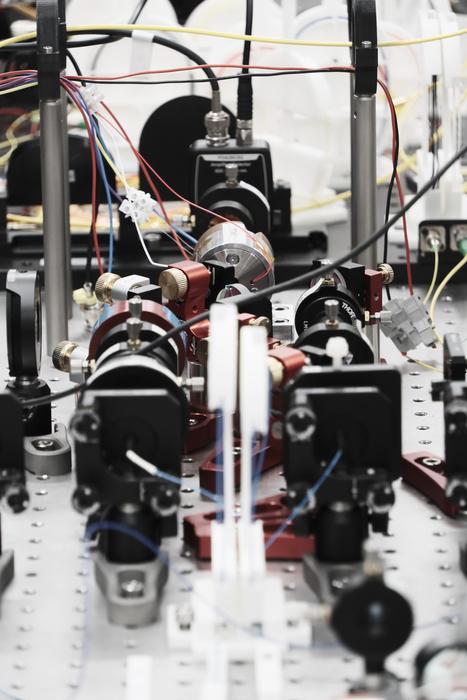
In a basement laboratory at the Technical University of Denmark, researchers have achieved something that sounds like science fiction: they’ve reduced a learning task that would take classical systems 20 million years to complete down to just 15 minutes. The secret weapon? Entangled light.
The breakthrough, published today in Science, represents the first proven quantum advantage for a photonic system – a milestone that researchers have been chasing for years as quantum technology promises continue to outpace practical demonstrations.
“This is the first proven quantum advantage for a photonic system,” says corresponding author Ulrik Lund Andersen, a professor at DTU Physics. “Knowing that such an advantage is possible with a straightforward optical setup should help others look for areas where this approach would pay off, such as sensing and machine learning.”
The experiment tackled a problem that plagues scientists across disciplines: understanding the “noise fingerprint” of complex systems. Traditional approaches require an exponentially growing number of measurements as systems become more sophisticated, quickly reaching impractical or impossible territory. Think of trying to map every grain of sand on a beach by examining one grain at a time – except the beach keeps growing.
The Magic of Quantum Entanglement
The Danish team’s solution leverages one of quantum mechanics’ most peculiar features: entanglement. When two particles or light beams become entangled, they remain mysteriously connected regardless of the distance separating them. Measuring one instantly reveals information about its partner, a phenomenon Einstein famously called “spooky action at a distance.”
The researchers created two entangled beams of light in their basement setup. One beam probed the system under study while the other served as a reference. By comparing both beams simultaneously in what they call a “joint measurement,” they could cancel out much of the measurement noise and extract far more information per trial than examining the probe beam alone.
The results were staggering: a sample complexity reduction of 11.8 orders of magnitude compared to classical methods. To put this in perspective, if classical approaches needed to run measurements for the age of the universe, the quantum method would finish during a coffee break.
Real-World Impact Beyond the Lab
What makes this achievement particularly compelling is its practicality. The experiment operates at standard telecommunications wavelengths using well-known optical components, and it works even with the ordinary losses that plague real-world setups. This isn’t a fragile quantum effect that only functions under pristine laboratory conditions.
“Even though a lot of people are talking about quantum technology and how they outperform classical computers, the fact remains that today, they don’t,” notes Jonas Schou Neergaard-Nielsen, an associate professor at DTU Physics and co-author. “So, what satisfies us is primarily that we have finally found a quantum mechanical system that does something no classical system will ever be able to do.”
The researchers acknowledge they haven’t yet targeted a concrete real-world application, but the implications ripple across multiple fields. Machine learning algorithms that need to characterize complex systems could see dramatic speedups. Quantum sensors trying to detect minute changes in gravitational waves or magnetic fields could operate with unprecedented efficiency.
The work builds on theoretical foundations the team established earlier this year, where they proved that entangled light could solve the exponential scaling problem that has long frustrated researchers. The basement experiment at DTU Physics transformed that mathematical promise into physical reality.
Unlike previous quantum advantage claims that often involved highly specialized problems with questionable practical relevance, this demonstration addresses a fundamental challenge that appears throughout science and engineering. The ability to rapidly learn the behavior of noisy, complex systems could accelerate everything from drug discovery to climate modeling.
As quantum technologies continue their march from laboratory curiosities toward commercial applications, this work provides a crucial proof point. It shows that quantum advantage isn’t just theoretically possible – it’s achievable with current technology, waiting for the right problems to unlock its potential.
The research involved collaboration with institutions across three continents, including the University of Chicago, MIT, Caltech, and the Korea Advanced Institute of Science and Technology, highlighting the global nature of the quantum race.