Skip to content
ScienceBlog.com
  • Featured Blogs
    • EU Horizon Blog
    • ESA Tracker
    • Experimental Frontiers
    • Josh Mitteldorf’s Aging Matters
    • Dr. Lu Zhang’s Gondwanaland
    • NeuroEdge
    • NIAAA
    • SciChi
    • The Poetry of Science
    • Wild Science
  • Topics
    • Brain & Behavior
    • Earth, Energy & Environment
    • Health
    • Life & Non-humans
    • Physics & Mathematics
    • Social Sciences
    • Space
    • Technology
  • Our Substack
  • Follow Us!
    • Bluesky
    • Threads
    • FaceBook
    • Google News
    • Twitter/X
  • Contribute/Contact

materials science

Rendering of the photonic topological insulator developed in the study

How a tiny device could lead to big physics discoveries and better lasers

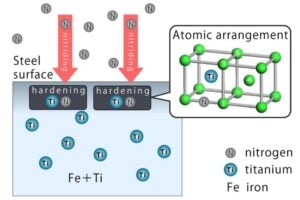
Model of stable configuration of nitrogen and titanium in steel of iron-titanium alloy

Unlocking the Secrets of High-Performance Steel for Electric Vehicle Motors

Scientists use generative AI to answer complex questions in physics

Scientists use generative AI to answer complex questions in physics

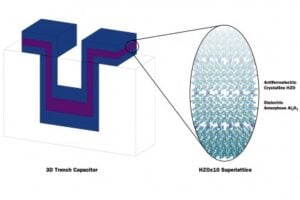
Microcapacitors made with engineered hafnium oxide/zirconium oxide films in 3D trench capacitor structures -- the same structures used in modern microelectronics -- achieve record-high energy storage and power density, paving the way for on-chip energy storage.

Groundbreaking Microcapacitors Could Power Chips of the Future

An artistic rendering of a copper oxide crystal, with electrons moving diagonally through the cube-shaped structure. The crystal is bathed in sunlight, symbolizing its potential for solar energy conversion and clean hydrogen fuel generation.

Twisting Copper Oxide Crystals Boosts Sustainable Fuel Generation

An artistic rendering of a rainbow-colored diamond growing from a liquid metal alloy, with the chemical symbols for gallium (Ga), iron (Fe), nickel (Ni), and silicon (Si) surrounding it

Diamond Growth Method Discovered at Lower Pressure and Temperature

These soft materials (chicken on the left and tomato on the right) permanently stick to hard surfaces just by passing electricity through them.

You don’t need glue to hold these materials together — just electricity

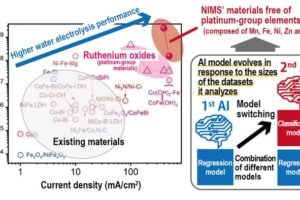
This research team developed an AI technique capable of accurately predicting the compositions of materials with desirable characteristics by switching prediction models depending on the sizes of the datasets available for analysis.

AI Accelerates Discovery of Affordable Materials for Green Hydrogen Production

Turning glass into a ‘transparent’ light-energy harvester

Turning glass into a ‘transparent’ light-energy harvester

Still image of trapped gas atoms

Scientists trap krypton atoms to form one-dimensional gas

Electric car charging

Solid state battery design charges in minutes, lasts for thousands of cycles

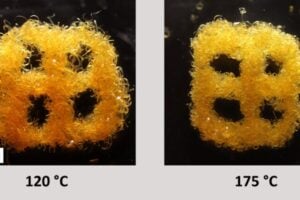
The shape-changing polymer ribbons can change their volume upon an environmental change, like temperature. Courtesy of Taylor Ware

Fire Ant ‘Rafts’ Inspire Engineering Research

ice illustration

Even far below freezing, ice’s surface begins melting as temperatures rise

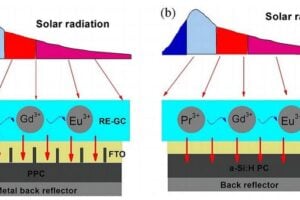
Applying a transparent Pr3+/Eu3+-doped glass-ceramic layer on top of a photovoltaic cell simultaneously protects it from damaging UV light and converts that UV radiation to visible light, thereby enhancing the light-to-energy conversion efficiency.

Boosting solar cell performance with a transparent spectral converter

Older posts
Newer posts
← Previous Page1 Page2 Page3 Page4 Next →
Substack subscription form sign up

Comments

  • Karoly Mirnics on Common Prescription Drugs May Disrupt Cholesterol Pathways in the Womb and Raise Autism Risk
  • Aizen on Laziness helped lead to extinction of Homo erectus
  • Norwood johnson on Electrons in New Crystals Behave as If They Live in Four Dimensions
  • ScienceBlog.com on Hidden Geometry Could Finally Fix Quantum Computers
  • Theo Prinse on America Is Going Back to the Moon. This Time, It Plans to Stay
© 2026 ScienceBlog.com | Follow our RSS / XML feed