

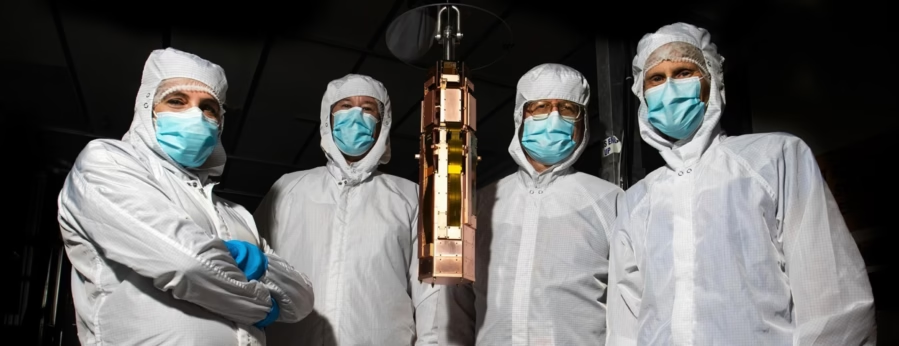
Key Takeaways
- SuperCDMS SNOLAB has achieved base temperature to detect dark matter particles passing through Earth.
- This experiment uses superconducting sensors in ultra-pure silicon and germanium crystals to register tiny signals from dark matter.
- It targets lightweight dark matter particles, which previous experiments have not explored thoroughly.
- The system includes multiple readout channels and AI-enabled signal reconstruction for improved data quality.
- The first science run is anticipated to start in 2026, potentially yielding insights into light dark matter.
Right now, something is passing through you. Not occasionally, not in bursts, but constantly, in a ceaseless invisible flood. If current physics is right, dark matter particles are moving through your body at this moment, through the chair you’re sitting on, through the floor beneath that, through the rock beneath the floor, all the way down through the crust and mantle of the Earth below. They have been doing this your entire life. You have never noticed. Neither has any detector humanity has ever built.
That, more or less, is the problem. Dark matter accounts for roughly 85 percent of all matter in the universe; it shapes the rotation of galaxies and anchors the large-scale structure of the cosmos, yet it interacts so weakly with ordinary matter that it remains, as of this writing, entirely undetected. Something has to give. And deep in a Canadian nickel mine, two kilometers underground, a new experiment has just quietly crossed a threshold that might finally change things.
The Super Cryogenic Dark Matter Search, known as SuperCDMS SNOLAB, has reached base temperature. For most physics experiments, that phrase means little. For this one, it means everything. The detectors at the heart of the experiment are superconducting sensors built into crystals of ultra-pure silicon and germanium, each roughly the size of a hockey puck, and they simply cannot function above a certain temperature threshold. That threshold is around 15 to 30 millikelvins: thousandths of a degree above absolute zero, where atomic motion almost entirely ceases. Outer space, for comparison, is about 2.7 kelvins, which works out to roughly a hundred times warmer than where these detectors now sit.
“The detectors simply don’t function unless they’re cold enough to enter the superconducting transition,” said Richard Partridge, the SLAC scientist who has managed the experiment’s installation. “For us, that means roughly 15 to 30 millikelvins.”
The chill is not merely impressive. It is functional. When a dark matter particle strikes one of the germanium or silicon crystals (if it ever does), it will deposit a tiny amount of energy, causing the crystal lattice to vibrate in a pattern called a phonon. The electrical signal produced is extraordinarily faint. At any temperature even slightly warmer than the operating point, the random thermal jostling of atoms would mask the signal entirely. Drop the crystals to millikelvin temperatures, though, and something remarkable happens.
“When everything is that cold, the crystals are basically quiet,” Partridge said. “Even very small energy deposits become detectable.”
Getting 24 detector units to this temperature inside a working experiment is a process that took years of preparation and months of staged cooldown. The system cannot simply be switched on and left to reach equilibrium. Cooling proceeds through a carefully managed sequence of stages, dropping through 50 kelvins, then 4 kelvins, then 1 kelvin, then finally into the millikelvin range, with separate systems managing the readout cables to prevent them introducing warmth into the detector array. Kelly Stifter, a Panofsky Fellow at SLAC who has been central to the project, is fairly direct about the experience of waiting for this moment.
“For the past two years, we’ve been installing the experiment in anticipation of this moment,” she said. “Dark matter is going through us all the time. Our challenge is to build a detector quiet and sensitive enough to notice when one of those particles interacts.”
What makes SuperCDMS particularly interesting, beyond the engineering, is the specific region of dark matter parameter space it is designed to probe. Earlier searches, including SuperCDMS’s own predecessor experiment at the Soudan Underground Laboratory in Minnesota, focused largely on heavier dark matter candidates. SuperCDMS SNOLAB is designed to look much lighter: particles with masses between roughly half a proton mass and five proton masses. This is territory that, as Stifter put it, “not many searches have really explored before,” and there are theoretical reasons to think it might repay investigation. Several candidate particles at this mass range (including certain dark photon models and light WIMPs, or weakly interacting massive particles) have been proposed as the carriers of the dark matter that makes up the missing mass of the universe.
The sensitivity required to find them is possible partly because each detector in the new experiment carries considerably more sensors than its predecessors did. Where earlier SuperCDMS detectors had limited readout channels, the SNOLAB generation includes multiple channels per crystal, combined with AI-enabled signal reconstruction and new simulation tools. Noah Kurinsky, who helped design the detectors, described the data quality as substantially richer than originally anticipated. “Every day will be new,” he said. “This is new science from day one.”
The experiment will not be ready to produce results immediately. Base temperature marks the transition from construction to commissioning, a months-long process of powering up, calibrating and troubleshooting each of the 24 detectors and their readout channels. The first science run, expected to last about a year, should begin sometime later in 2026. But even the first data, perhaps in the first few months, could in principle be enough to either detect light dark matter or significantly constrain the parameter space where it might lurk. Priscilla Cushman, a physicist at the University of Minnesota and the spokesperson for the SuperCDMS collaboration, described the moment as the culmination of a years-long campaign to build the right kind of silence underground: a low-background facility where trace radioactivity is suppressed by layers of ultra-pure lead and high-density polyethylene, and where cosmic rays are blocked by two kilometers of rock. That silence is now, finally, cold enough to listen.
Whether something answers is another question entirely.
Source: SLAC National Accelerator Laboratory
Frequently Asked Questions
SuperCDMS (Super Cryogenic Dark Matter Search) is an experiment designed to detect dark matter particles that pass through Earth. It is located roughly 2 kilometers underground in an active nickel mine near Sudbury, Ontario, because the rock above shields the detectors from cosmic rays and other background radiation that could overwhelm the faint signals the experiment is looking for.
The detectors use superconducting sensors that only work below a certain temperature threshold, around 15 to 30 millikelvins. At these temperatures, the random thermal motion of atoms in the crystals is almost entirely suppressed, allowing the detectors to register extremely faint signals, like the tiny vibration that would be produced if a dark matter particle struck the crystal lattice.
SuperCDMS is designed to detect light dark matter: particles with masses roughly between half a proton mass and five times the proton mass. This mass range has been largely unexplored by previous direct-detection experiments, and several theoretical candidates, including certain weakly interacting massive particles and dark photon models, fall within it.
When a dark matter particle strikes one of the silicon or germanium crystals, it produces two signals: a tiny crystal lattice vibration (a phonon) and a small electrical charge. The superconducting sensors detect both. By analyzing the combination and energy of these signals, researchers can distinguish potential dark matter interactions from the background noise of other particles.
The experiment is currently in a commissioning phase, turning on and calibrating each of its 24 detectors. The first science run is expected to begin later in 2026 and last approximately one year. Initial data from the first few months could potentially be enough to either detect light dark matter or significantly constrain where it might be found.