

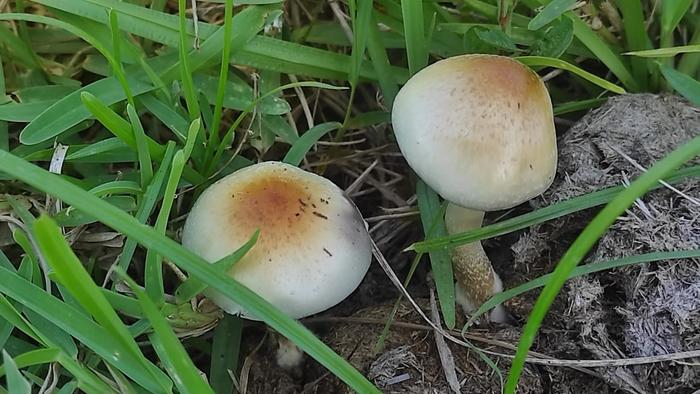
Cathy Sharp found the first one in January 2013, growing out of decomposed herbivore dung in the rocky, mixed-deciduous woodland of the Matobo Hills in southern Zimbabwe. It looked, in most respects, like the classic magic mushroom everyone knows from cultivation guides and internet forums. Cream-coloured cap with a distinctive ochre-yellow centre, bruising instantly to blue-green wherever it was handled, the usual slightly earthy mushroom smell. Sharp collected it, dried it carefully, and filed it away at the Natural History Museum of Zimbabwe under the working label of an unknown Psilocybe species. Nobody, at that point, had any idea what she had.
It took a decade, a transatlantic collaboration, DNA extracted from museum type specimens going back to 1904, and a suite of molecular clock analyses to figure it out. What Sharp had found in the Zimbabwean grassland was not a local variant of Psilocybe cubensis, the domesticated magic mushroom used in ceremonies across Mexico and now cultivated globally by a subculture of millions. It was a separate species that last shared a common ancestor with P. cubensis roughly 1.56 million years ago. Before Homo sapiens existed. Before cattle were domesticated. Long before any Spanish ship crossed the Atlantic.
The new species, formally named Psilocybe ochraceocentrata after the ochre-yellow spot at the centre of its cap, is described in Proceedings of the Royal Society B by a team from Clark University, Stellenbosch University, Duke University, the University of Utah, and the Natural History Museum of Zimbabwe. It matters for several overlapping reasons, not all of them immediately obvious.
The most immediate is that P. ochraceocentrata has been sold and cultivated worldwide for years without anyone realising what it actually was. The strains marketed by cultivators as “NSS” (Natal Super Strength) or “Transkei” and widely regarded as exceptionally potent and easy to grow are, the molecular data now confirms, P. ochraceocentrata. Not a variant of the classic cubensis. A different species entirely. “It’s one of the most popular strains of magic mushrooms, because it is quite potent and easy to grow,” says Breyten van der Merwe, a mycologist and PhD student at Stellenbosch University and one of the paper’s co-authors. “But until this study, nobody realised it was a totally separate species from the classic magic mushroom.”
The bigger story, though, is evolutionary. For decades the prevailing explanation for why P. cubensis turned up in the Americas at all rested on a hypothesis first proposed in 1983 by the Mexican mycologist Gastón Guzmán. His argument ran roughly like this: P. cubensis originated in Africa, hitched a ride in the gut of cattle brought over by Spanish colonisers in the 1490s and 1500s, and established itself in New World pastures from Cuba southward. The hypothesis was plausible and widely accepted. It was also, until very recently, untested, largely because the African fungi that might confirm it had never been properly sampled.
What the new analysis actually shows is considerably more complicated. At the latest end of the molecular clock’s confidence interval, the divergence of P. ochraceocentrata and P. cubensis happened about 710,000 years ago. At the earliest end, closer to 2.55 million years ago. Even the conservative estimate predates cattle domestication by a factor of roughly seventy. The Guzmán scenario required P. cubensis to have existed in Africa recently enough to travel to Cuba aboard a sixteenth-century galleon, and then gone extinct there. The new divergence dating makes that sequence of events unlikely, though the authors are careful not to rule it out entirely. What the ecological niche modelling suggests instead is that P. cubensis may have been present in the Americas for hundreds of thousands of years before Europeans arrived, following bison as they expanded across the grasslands of North and Central America from their own Asian origins.
The timing of the divergence itself is striking. It coincides with the Pleistocene expansion of C4 grasslands across East Africa, the same ecosystem transformation that produced the large grazing herbivores both species still depend on for growth today. Both P. cubensis and P. ochraceocentrata grow on herbivore dung; this appears to be an ancestral habit, not something acquired through association with domesticated cattle. Around 1.5 million years ago, give or take several hundred thousand years, their common ancestor was probably following migrating bovids across sub-Saharan grasslands. And then the population split, for reasons the analysis can suggest but not confirm, the two lineages diverging as habitat connected Africa to Eurasia shifted with climate. Homo erectus, as it happens, was spreading from Africa through Eurasia at roughly the same time, using the same bovid migration corridors. The parallel is tantalising but speculative, and the paper treats it as such.
What the study cannot do, the authors acknowledge, is actually confirm where P. cubensis originated. The niche modelling shows plausible historical ranges across the Americas, Southeast Asia, and Africa simultaneously. Australia appears to be a recent arrival, consistent with separate genetic evidence suggesting low diversity there. Whether the Americas were an original range or a secondary colonisation remains genuinely open. “The findings shed new light on the wild origins of domesticated P. cubensis,” van der Merwe notes, “and provide new genetic resources for research on psychedelic mushrooms,” but the picture is more complicated than a single clean origin story.
There is also the deeper problem of how little anyone actually knows about African Psilocybe. Only seven species from the entire continent have been formally described and typified, including P. ochraceocentrata. Africa is, mycologically speaking, radically undersampled. Sharp’s 2013 Zimbabwe collection sat in a museum drawer for a decade not because it was overlooked but because the taxonomic infrastructure to identify it simply did not exist. The legal restrictions on psilocybin and psilocin that have hampered research globally have fallen disproportionately on exactly this kind of foundational biodiversity work, where the question is not whether a molecule has therapeutic effects but what species are out there producing it and in what ecological relationships.
That matters increasingly as research programs chase psilocybin as a treatment for depression, OCD, addiction, and other psychiatric conditions. The molecular data from P. ochraceocentrata, and the first-ever sequencing of the holotype of Stropharia cubensis Earle (the 1904 Cuban specimen that is still the reference for the entire species), provide a cleaner genetic baseline than has previously existed. Which strains are which species, what chemical profiles distinguish them, and whether those differences translate into different therapeutic properties are questions that have been, until now, harder to answer than they should be. The NSS/Transkei misidentification is a modest but concrete example of what taxonomic confusion costs in practice.
Whether the Matobo Hills were the ancestral home of the world’s most cultivated psychedelic mushroom or merely the location of its closest surviving wild relative, the discovery of P. ochraceocentrata reshapes how the question can even be asked. Africa’s fungal biodiversity remains largely a matter of inference and prediction. Sharp’s field notes from January 2013 are, most likely, just the beginning of what is there.
DOI / Source: https://doi.org/10.1098/rspb.2025.2270
Frequently Asked Questions
Not necessarily, and the researchers are careful to say so. The new analysis shows that P. cubensis and its closest wild relative, P. ochraceocentrata, last shared a common ancestor roughly 1.5 million years ago, long before cattle were domesticated or Europeans reached the Americas. Ecological modelling suggests P. cubensis may have existed in the Americas for hundreds of thousands of years before Europeans arrived, potentially following migrating bison. The traditional idea that it was brought over aboard Spanish ships in the 1500s now looks much less likely, but pinning down a single origin remains beyond what the current data can support.
It turns out to be an entirely separate species from the classic magic mushroom, Psilocybe cubensis. The strains sold under the cultivator names “NSS” (Natal Super Strength) and “Transkei” have been circulating in the mushroom cultivation community for years, prized for their potency and ease of growing, but the DNA sequencing in this study confirms they belong to P. ochraceocentrata, the newly described African species. Whether this species difference translates into meaningfully different chemical or therapeutic properties is not yet known.
Two main reasons. First, Africa is systematically undersampled for fungal biodiversity generally, a consequence of limited research infrastructure and historical gaps in mycological fieldwork. Only seven Psilocybe species from the entire continent have been formally described. Second, legal restrictions on psilocybin and psilocin have constrained the collecting and characterisation of fungi that might contain these compounds, even for basic taxonomy: precisely the work needed to understand what species exist and where.
By comparing DNA sequences across multiple genes and calibrating the rate at which those sequences accumulate mutations over time. In this study, the team used molecular clock analysis on three protein-coding genes, anchored to a known reference point in Psilocybe evolutionary history, to estimate when P. ochraceocentrata and P. cubensis last had a common ancestor. The resulting estimate, roughly 1.56 million years ago with a range of about 710,000 to 2.55 million years, places the split firmly in the Pleistocene, a period that also saw the expansion of C4 grasslands and the large herbivores both species still depend on today.
Potentially yes, which is part of why taxonomic accuracy matters. Psilocybin is being studied as a treatment for depression, OCD, addiction, and other conditions, and understanding which species produce which compounds in what quantities depends on knowing exactly what species you are working with. The NSS/Transkei misidentification shows in miniature what confusion costs: researchers or producers who thought they were working with P. cubensis were actually working with a different species. This study provides the first sequencing of the 1904 Cuban holotype that defines P. cubensis, giving the field a more reliable genetic reference point for the first time.
Key Takeaways
- Cathy Sharp discovered a new mushroom species, Psilocybe ochraceocentrata, in Zimbabwe in 2013 after years of research.
- This species was misidentified in the past; strains sold as ‘NSS’ and ‘Transkei’ are actually P. ochraceocentrata, not P. cubensis.
- The divergence between P. ochraceocentrata and P. cubensis occurred 710,000 to 2.55 million years ago, complicating earlier theories on their origins.
- Research shows that Psilocybe species may have existed in the Americas long before European colonization, contradicting previous assumptions.
- The study highlights Africa’s under-researched fungal biodiversity and how taxonomic accuracy is crucial for future psychedelic research.