

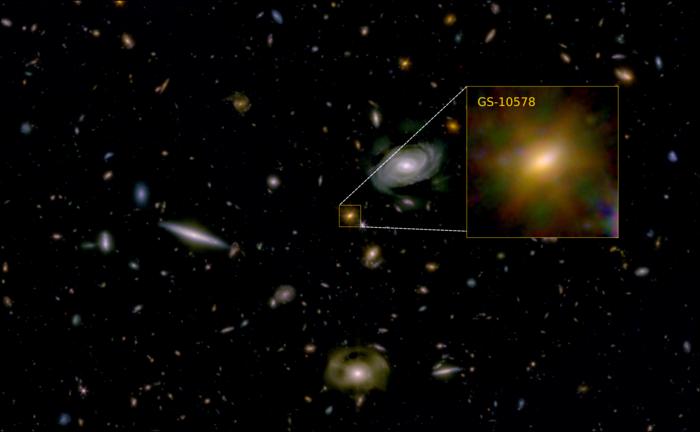
Not every giant goes out with a bang. Some simply stop eating.
Astronomers studying the early universe have found a massive galaxy that quit making stars not because something smashed into it, but because a black hole at its center kept pushing the groceries away. The galaxy, nicknamed “Pablo’s Galaxy,” existed just three billion years after the Big Bang, yet it had already gone quiet. Its stars had formed in a furious burst and then, over a relatively short stretch of cosmic time, the raw material for new ones simply vanished.
Using the James Webb Space Telescope and the Atacama Large Millimeter Array in Chile, a team led by researchers at the University of Cambridge went looking for cold gas, the fuel galaxies need to build stars. They searched for nearly seven hours. They found almost nothing. Less than one percent of the galaxy’s mass remained in usable fuel.
A black hole that kept the tank empty
Pablo’s Galaxy is enormous for its age, roughly 200 billion times the mass of our sun. Most of its stars formed between 12.5 and 11.5 billion years ago, a window of perhaps a billion years. Then the factory shut down.
The Webb telescope revealed why. Neutral gas winds were streaming away from the central black hole at about 400 kilometers per second, carrying off some 60 solar masses of material each year. At that rate, any leftover fuel would disappear in tens of millions of years, a blink in cosmic terms.
What makes this finding unusual is that the galaxy still looks calm. It rotates smoothly, like a pinwheel. There is no sign of a collision or merger, the kind of violent event astronomers often blame when a galaxy stops forming stars. Instead, the black hole appears to have acted like a slow leak, repeatedly warming incoming gas or blowing it away before it could settle and condense.
“You don’t need a single cataclysm to stop a galaxy forming stars,” said Jan Scholtz of the University of Cambridge. “Just keep the fresh fuel from coming in.”
A common fate?
Before Webb, galaxies this massive and this old were thought to be rare accidents. Now they are turning up regularly in the early universe, and Pablo’s Galaxy offers a possible explanation for how they got that way. The black hole did not tear the galaxy apart. It simply starved it, one meal at a time.
The Cambridge team has already been granted more time on the Webb telescope to look for warmer gas around the galaxy, which could reveal whether this quiet form of shutdown is the rule rather than the exception. For now, the finding is a reminder that cosmic death does not always look dramatic. Sometimes a galaxy just runs out of breath.