

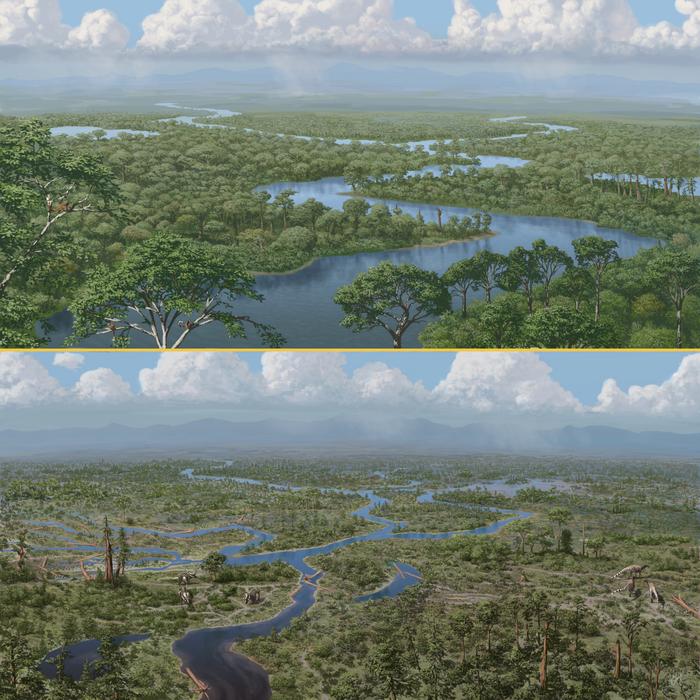
The sudden extinction of dinosaurs 66 million years ago didn’t just end the age of giant reptiles—it fundamentally reshaped how water flowed across continents, according to groundbreaking University of Michigan research that challenges how we think about life’s impact on Earth’s geology.
Scientists have long puzzled over dramatic changes in rock formations that occurred precisely when dinosaurs vanished, typically attributing these shifts to rising sea levels or mountain building. But new evidence suggests something far more intriguing: dinosaurs themselves were “ecosystem engineers” whose massive bodies and behaviors prevented dense forests from growing, and their sudden absence allowed vegetation to explode across landscapes in ways that completely altered river systems.
Luke Weaver, a University of Michigan paleontologist, discovered this connection while examining rock layers across the western United States that span the boundary between the dinosaur age and the age of mammals. What he found was a consistent pattern that had been hiding in plain sight.
Rivers Before and After the Great Dying
Before dinosaurs died out, rivers meandered lazily across open landscapes, frequently changing course and spilling sediment widely across floodplains. The rock record from this period shows thin channel deposits and waterlogged soils—the geological signature of unstable, wandering waterways.
But immediately after the extinction event, everything changed. Rivers became deeply entrenched with broad, stable meanders, carving permanent channels bordered by dense forests. The rock formations reflect this shift dramatically: thick sandstone deposits representing large, long-lived river channels, interspersed with coal beds formed in newly established swamps.
“Very often when we’re thinking about how life has changed through time and how environments change through time, it’s usually that the climate changes and, therefore, it has a specific effect on life,” said Weaver. “It’s rarely thought that life itself could actually alter the climate and the landscape. The arrow doesn’t just go in one direction.”
The research team examined locations throughout Montana, Wyoming, and the Dakotas, finding the same geological transition occurring precisely at the level where asteroid debris from the Chicxulub impact can be detected—a fine clay layer enriched with the rare element iridium that marks the moment 66 million years ago when a six-mile-wide space rock slammed into Mexico’s Yucatan Peninsula.
Massive Herbivores as Landscape Architects
The key insight came when Weaver connected modern studies of how large animals shape their environments with the ancient geological record. Today’s elephants, for example, are known to maintain open savannas by knocking down trees and trampling vegetation. Remove the elephants, and dense forests quickly take over.
Dinosaurs were far larger than any modern land animal. A typical large herbivorous dinosaur like Triceratops could weigh 15,000 kilograms—roughly the mass of three elephants. These giants traveled in herds, accompanied by massive predators like Tyrannosaurus rex weighing 8,000 kilograms.
“Dinosaurs are huge. They must have had some sort of impact on this vegetation,” Weaver realized during his “light bulb moment” while listening to talks about modern animal ecology.
The evidence suggests these enormous herbivores maintained open, park-like landscapes through constant trampling and vegetation destruction. This kept the ground between scattered trees weedy and unstable, allowing rivers to shift course frequently and spread sediment across broad areas.
When the asteroid impact eliminated these biological bulldozers virtually overnight, dense forests could establish for the first time in millions of years. The newly stable root systems locked river channels in place, creating the meandering waterways whose deposits are preserved as the colorful “pajama-striped” rock formations that define the early age of mammals.
The transformation was remarkably rapid in geological terms. Within thousands of years after the extinction, river systems across an area spanning 30 degrees of latitude had completely reorganized themselves. Coal swamps—rare during the dinosaur age—became common features of the landscape as organic matter accumulated in the newly stable floodplains.
This research provides crucial insights for understanding how quickly Earth systems can change when major ecosystem components disappear. The findings appear in Communications Earth & Environment, demonstrating that mass extinctions don’t just eliminate species—they can trigger cascading changes that reshape entire continents.
The study also offers a sobering parallel to today’s biodiversity crisis. Human activities are driving extinction rates comparable to ancient mass extinction events, potentially triggering similarly dramatic but unpredictable changes to Earth’s climate and landscapes.
The dinosaur extinction boundary represents what Weaver calls “our best analog to our very abrupt restructuring of biodiversity, landscapes and climate” happening in modern times. Just as the loss of dinosaur ecosystem engineers transformed ancient river systems, the current loss of large animals and forest cover may be setting the stage for equally profound changes to Earth’s future geology.
Communications Earth & Environment: 10.1038/s43247-025-02673-8