Hubble Captures Ultra-Fast Interstellar Comet Racing Through Solar System at Record Speed

This is a Hubble Space telescope image of the interstellar comet 3I/ATLAS. Hubble photographed the comet on 21 July 21 2025, when the comet was 445 million kilometres from Earth. Hubble shows that the comet has a teardrop-shaped cocoon of dust coming off its solid, icy nucleus. Because Hubble was tracking the comet moving along a hyperbolic trajectory, the stationary background stars are streaked in the exposure. [Image description: At the center of the image is a comet that appears as a teardrop-shaped bluish cocoon of dust coming off the comet’s solid, icy nucleus and seen against a black background. The comet appears to be heading to the bottom left corner of the image. About a dozen short, light blue diagonal streaks are seen scattered across the image, which are from background stars that appeared to move during the exposure because the telescope was tracking the moving comet.]

The Hubble Space Telescope has captured the clearest images yet of a rare interstellar visitor speeding through our solar system at an unprecedented 210,000 kilometers per hour, making it the fastest object ever recorded in our cosmic neighborhood. The comet, designated 3I/ATLAS, represents only the third known interstellar interloper detected in our solar system, following … Read more

Astronomers Catch a Solar System Being Born — for the First Time Ever

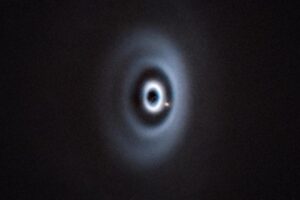
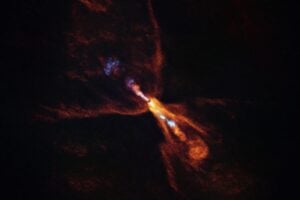
This is HOPS-315, a baby star where astronomers have observed evidence for the earliest stages of planet formation. Image credit: ALMA(ESO/NAOJ/NRAO)/M. McClure et al.

Scientists have witnessed the earliest stages of planet formation ever observed, watching hot minerals crystallize into solid particles around a baby star 1,300 light-years away. This discovery, published in Nature, marks the first time researchers have caught a planetary system at the very moment when planets begin to form—providing a cosmic time machine to study … Read more

Star’s Double Death Captured in Stunning Image

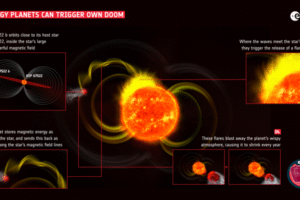
VLT image of a double-detonation supernova

A stellar detective story hundreds of years in the making has finally reached its conclusion. Astronomers using the European Southern Observatory’s Very Large Telescope have captured the first visual evidence of a star that died not once, but twice—exploding in a rare double-detonation that left behind a distinctive fingerprint in the cosmic debris. The discovery … Read more

Space Radar Sees Through Amazon Canopy to Map Earth’s Carbon

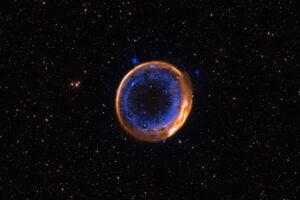
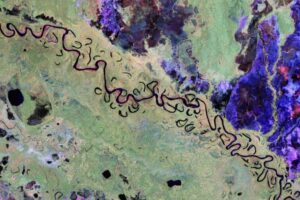
Bolivian forest and landscape from Biomass

Two months after launch, Europe’s Biomass satellite has returned its first images—and they’re already revealing hidden secrets beneath some of the world’s most impenetrable forests. The spacecraft’s advanced radar can peer through dense Amazon canopies to measure the carbon locked inside tree trunks and branches, offering scientists an unprecedented tool for tracking how forests store … Read more

Flyeye Telescope Opens Eye to Hunt Dangerous Asteroids

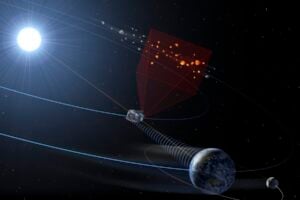
Delegates visit the Flyeye telescope at its factory in Matera, Italy, on 4 June during its final test campaign

Europe’s newest guardian against cosmic threats has begun its watch. The European Space Agency’s Flyeye telescope achieved “first light” in late May, marking a pivotal moment for planetary defense as it started scanning the heavens for potentially hazardous near-Earth asteroids and comets. Unlike traditional telescopes that peer through a narrow window, this innovative system captures … Read more

European Space Agency Tracker

Not Affiliated with the European Space Agency, Just Covering It

Skip to content ↓