Spooky Cosmic Bat Unfurls Its Wings Over Chile

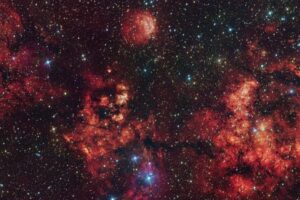
A spooky bat has been spotted flying over the European Southern Observatory’s (ESO’s) Paranal site in Chile, right in time for Halloween. Thanks to its wide field of view, the VLT Survey Telescope (VST) was able to capture this large cloud of cosmic gas and dust, whose mesmerising appearance resembles the silhouette of a bat.

High above the Atacama Desert, a crimson apparition stretches across the night sky. Just in time for Halloween, astronomers at the European Southern Observatory (ESO) have captured a vast cloud of gas and dust shaped like a flying bat, its wings outlined in starlight. The eerie figure, located about 10,000 light-years from Earth, offers both … Read more

Dust-Cloaked Star Solves Supernova Mystery

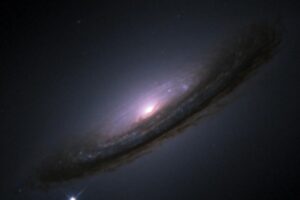
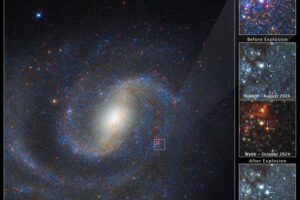
The main image at left shows a combined Webb and Hubble view of spiral galaxy NGC 1637, with the region of interest in the top right. The remaining three panels show a detailed view of a red supergiant star before and after it exploded. The star is not visible in the Hubble image before the explosion, but appears in the Webb image. The July 2025 view from Hubble shows the glowing aftermath of the explosion.

Astronomers have spent decades scratching their heads over a cosmic puzzle: massive red supergiant stars should explode all the time, yet we rarely see them do it. The answer, it turns out, was hiding in plain sight. Or rather, hiding behind a thick veil of dust. A Northwestern University-led team used NASA’s James Webb Space … Read more

Cassini Data Uncovers Complex Molecules on Icy Moon

Interior of Enceladus

Scientists combing through old spacecraft data have discovered something that makes Saturn’s tiny moon Enceladus look increasingly like a place where life could exist. Fresh organic molecules, spewing from cracks in the moon’s icy surface, suggest that sophisticated chemical reactions are happening in the ocean beneath. The findings, published today in Nature Astronomy, come from … Read more

Fly Through First 3D Map Revealing Hidden Star Factories

This is a still image of the animation showing Gaia’s star-formation map in 3D.

For the first time, astronomers have penetrated the cosmic dust veils shrouding stellar nurseries to create the most accurate three-dimensional map of star-forming regions within our galaxy. The breakthrough, using data from the European Space Agency’s Gaia space telescope, reveals how massive young stars carve cavities in space and illuminate the gas clouds that birth … Read more

Your Alien Neighbors Live 33,000 Light Years Away

Kepler 168

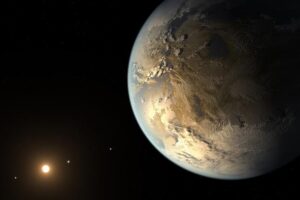
The search for extraterrestrial intelligence just got a reality check. According to new research presented at the EPSC-DPS2025 Joint Meeting in Helsinki, the closest technological alien civilization to Earth is likely sitting about 33,000 light years away – roughly on the opposite side of our galaxy. Even more sobering: that alien society would need to … Read more

Cosmic Explosion Defies Rules of the Universe

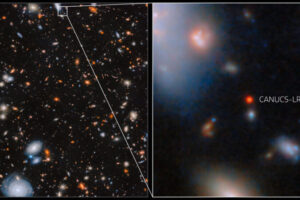
The orange dot at the center of this image marks a powerful explosion that flared several times over the course of a single day, an event never seen before. Captured with ESO’s Very Large Telescope (VLT), the image revealed that the source lay not in our Milky Way but in a distant galaxy.

The brightest explosions in space are supposed to be one-time events. This one went off again and again. On July 2, NASA’s Fermi Gamma-ray Space Telescope picked up a puzzling signal, later confirmed by Europe’s Very Large Telescope in Chile: a gamma-ray burst (GRB) that lasted a full day and repeated in discrete flashes. Astronomers … Read more

European Space Agency Tracker

Not Affiliated with the European Space Agency, Just Covering It

Skip to content ↓