

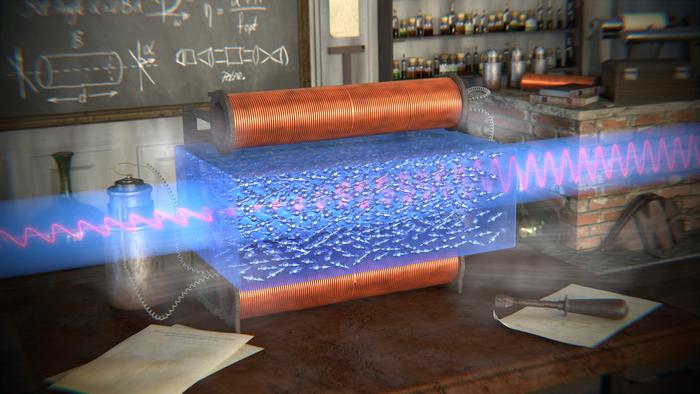
Light’s neglected magnetic side is finally being written into the physics of how it twists as it travels through magnetized matter.
In an experimental and theoretical study in Scientific Reports, researchers Benjamin Assouline and Amir Capua at the Hebrew University of Jerusalem show that the magnetic component of light makes a direct, sizeable contribution to the Faraday effect, a cornerstone magneto optic phenomenon first observed in 1845. By modeling and quantifying how light’s oscillating magnetic field generates torque on spins in a crystal called terbium gallium garnet, they find that this magnetic contribution can explain about 17 percent of the observed polarization rotation at 800 nanometers and up to roughly 70 percent in the infrared, overturning the long standing view that only light’s electric field really matters.
At the heart of the work is a shift in perspective about what the Faraday effect actually measures. For nearly two centuries, textbooks have framed it as an interaction between the electric field of light and electric charges in a material. Faraday himself saw only that a static magnetic field rotated the polarization of light passing through glass. The details were filled in later, almost entirely in electric field language.
Capua and Assouline instead start from the full Landau Lifshitz Gilbert equation, which tracks how magnetization vectors precess and relax in response to fields. They then let the optical magnetic field do something most theories have ignored, exert its own Zeeman torque on spins as circularly polarized light passes through a magnetized medium.
“In simple terms, it is an interaction between light and magnetism,” said Dr. Amir Capua of the Hebrew University of Jerusalem. “The static magnetic field ‘twists’ the light, and the light, in turn, reveals the magnetic properties of the material. What we have found is that the magnetic part of light has a first-order effect, it is surprisingly active in this process.”
In this picture, the light does more than bring energy and an oscillating electric field. Its magnetic field actively tilts the magnetization inside the material, adding a distinct contribution to the rotation of the polarization plane. The authors show that this optically induced torque builds up pulse by pulse, scales linearly with optical fluence, and appears in both ultrashort pulse and continuous wave regimes, reproducing experimental trends seen in inverse Faraday effect and all optical switching experiments.
A New Piece In The Faraday Puzzle
To quantify how big this neglected term really is, the team turned to terbium gallium garnet, a well studied paramagnetic crystal widely used in Faraday based optical components. Using material parameters such as its magnetic susceptibility and dielectric constant, they derived an explicit expression for the Verdet constant that comes purely from the optical magnetic field.
The result is strikingly simple and, within their approximations, wavelength independent apart from the material’s dispersion. When they plug in values appropriate for 800 nanometer light, the calculated magnetic contribution accounts for around 17.5 percent of the measured Verdet constant. At longer wavelengths, where the electric field contribution weakens, the magnetic term looms even larger, reaching about three quarters of the total rotation at 1.3 micrometers in their comparison with earlier measurements.
“Our results show that light ‘talks’ to matter not only through its electric field, but also through its magnetic field, a component that has been largely overlooked until now,” said co author Benjamin Assouline.
That conclusion does not make the electric field unimportant. The authors emphasize that magneto optic phenomena like the Faraday effect and its inverse still depend primarily on mechanisms driven by the electric field, including thermal, photomagnetic, and optomagnetic processes. The optical magnetic field, however, turns out to be a first order participant rather than a negligible correction, especially at longer wavelengths where its relative weight grows.
When Faraday And Its Inverse Part Ways
The same framework also offers a clean explanation for why the direct Faraday effect and the inverse Faraday effect refuse to share a single material constant once experiments push into ultrafast timescales. In classic phenomenological theories, both directions of the effect were treated as reciprocal, governed by the same magneto optic susceptibility.
Assouline and Capua show that this reciprocity breaks down naturally when one compares steady state Faraday rotation with femtosecond scale inverse Faraday dynamics. In the Faraday case, a static magnetic field and a continuous optical beam allow the system to reach near equilibrium, and the rotation angle depends mainly on static susceptibility. In the inverse case, circularly polarized pulses drive non adiabatic transitions in which magnetization and fields are far from equilibrium, so the effective Verdet constant depends on pulse duration, damping, and other dynamical parameters.
In their Landau Lifshitz Gilbert based treatment, the Verdet constants that describe the Faraday and inverse Faraday effects emerge from fundamentally different regimes and simply cannot be equal. That theoretical asymmetry matches experimental reports in which ultrafast optical switching and torque measurements repeatedly violated the old reciprocity assumption.
Looking ahead, the work suggests practical consequences as well as a conceptual correction. If light’s magnetic field can make a sizeable, predictable contribution to spin dynamics, it becomes another handle for engineering materials and devices in spintronics, optical data storage, and spin based quantum technologies. It may also help make sense of puzzling efficiencies in all optical switching experiments that seemed to outpace electric field based theories alone.
After 180 years, the Faraday effect has not been overturned so much as expanded. The familiar story of light’s electric field pushing charges now has a magnetic counterpart, in which the same beam quietly tugs on spins as it passes through, leaving a measurable twist behind.