Skip to content
ScienceBlog.com
  • Featured Blogs
    • EU Horizon Blog
    • ESA Tracker
    • Experimental Frontiers
    • Josh Mitteldorf’s Aging Matters
    • Dr. Lu Zhang’s Gondwanaland
    • NeuroEdge
    • NIAAA
    • SciChi
    • The Poetry of Science
    • Wild Science
  • Topics
    • Brain & Behavior
    • Earth, Energy & Environment
    • Health
    • Life & Non-humans
    • Physics & Mathematics
    • Social Sciences
    • Space
    • Technology
  • Our Substack
  • Follow Us!
    • Bluesky
    • Threads
    • FaceBook
    • Google News
    • Twitter/X
  • Contribute/Contact
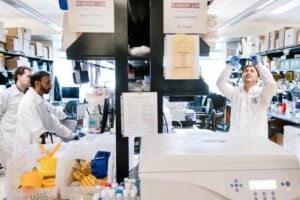
Scientists in the Marson Lab at Gladstone Institutes have opened a new door to understanding HIV by creating the first genetic roadmap of how the virus interacts with real human cells.

Hidden Proteins in Your Blood Could Stop HIV in Its Tracks

Bruce on a rock checking the photographer out

The Beak He Never Had Is the One He Uses to Win Every Fight

abstract time physics artwork

Atomic Clocks Can Now Tick Faster and Slower at the Same Time

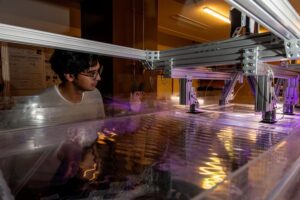
OIST PhD student Aditya Singh generates and observes surface waves that act as a classical analogue to quantum effects.

Swirling Vortex in Water Tank Reveals Hidden Geometry of Quantum World

abstract illustration

Vanished People Who Built France’s Megalithic Tombs Were Replaced by Strangers from Iberia

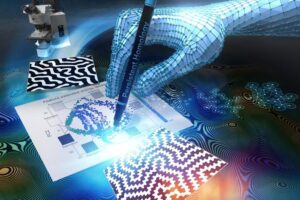
Researchers developed a model that finds structural patterns in images of magnetic regions, including irregular, maze-like shapes that older methods miss. By adding an entropy term to a classic physics equation, the model maps out an energy landscape that shows exactly what it costs, energetically, for a magnet to reverse its direction at different temperatures. The result is a clearer picture of the barriers a magnet must cross before it flips, and why temperature changes that process.

Maze Inside Your Motor Is Bleeding Energy. Scientists Just Figured Out Why

Corresponding author Karoly Mirnics, MD, PhD, dean and director of the Munroe-Meyer Institute; and lead author Eric Peeples, MD, PhD, assistant professor in the UNMC Division of Neonatology

Common Prescription Drugs May Disrupt Cholesterol Pathways in the Womb and Raise Autism Risk

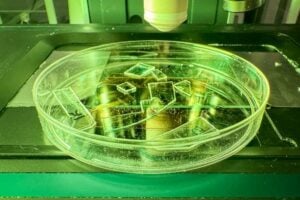
Transparent acrylic samples with engineered nanotextured surfaces, prepared for microscopy analysis, showing how clear plastic can be turned into a coating that physically tears viruses apart on contact. Image: RMIT

Plastic Film Kills Viruses by Tearing Them Apart

colorful forest fungus

Earth Fungus Might Survive a Trip to Mars

ocean waves

Ocean Circulation That Heats Europe Is on Track to Lose Half Its Strength by 2100

malaria mosquito

Malaria’s Hidden Toll: The Disease That Keeps Damaging Children’s Brains for a Decade

bowl of fructose

Why Fructose Behaves Less Like a Calorie and More Like a Hormone

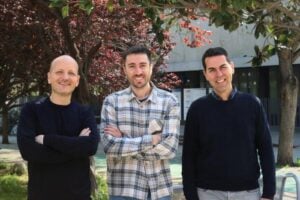
From left to right: Xavier Trepat, Pau Guillamat and Marino Arroyo.

Scientists Program Flat Sheets of Cells to Fold Themselves Into Bowls and Roses

From floods to wildfires, new ideas are helping Europe adapt to climate extremes

Older posts
Newer posts
← Previous Page1 … Page3 Page4 Page5 … Page5,945 Next →
Substack subscription form sign up

Comments

  • Dax on The Silent Frequency That Makes Old Buildings Feel Haunted
  • Karoly Mirnics on Common Prescription Drugs May Disrupt Cholesterol Pathways in the Womb and Raise Autism Risk
  • Aizen on Laziness helped lead to extinction of Homo erectus
  • Norwood johnson on Electrons in New Crystals Behave as If They Live in Four Dimensions
  • ScienceBlog.com on Hidden Geometry Could Finally Fix Quantum Computers
© 2026 ScienceBlog.com | Follow our RSS / XML feed