Skip to content
ScienceBlog.com
  • Featured Blogs
    • EU Horizon Blog
    • ESA Tracker
    • Experimental Frontiers
    • Josh Mitteldorf’s Aging Matters
    • Dr. Lu Zhang’s Gondwanaland
    • NeuroEdge
    • NIAAA
    • SciChi
    • The Poetry of Science
    • Wild Science
  • Topics
    • Brain & Behavior
    • Earth, Energy & Environment
    • Health
    • Life & Non-humans
    • Physics & Mathematics
    • Social Sciences
    • Space
    • Technology
  • Our Substack
  • Follow Us!
    • Bluesky
    • Threads
    • FaceBook
    • Google News
    • Twitter/X
  • Contribute/Contact
For the first time, researchers have utilized detailed factors such as water depth and temperature to better estimate the capacity for floating solar panels on U.S. reservoirs. Even under conservative projections, these reservoirs present enormous potential, with the ability to support projects generating up to 77,000 megawatts. (Photo: Getty Images)

Solar Panels Lose a Third of Their Gains to Coal Pollution, Global Study Finds

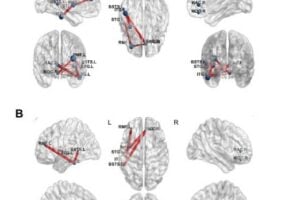
Researchers analyzed implanted brain-electrode recordings before and after radiofrequency thermocoagulation (RF-TC) to show how targeted heat treatment reshapes seizure-related brain networks.

A Brain on Fire Rewired: Heat Therapy for Epilepsy Works by Reshaping Entire Neural Networks

Six mix-and-match drink recipes could supply astronauts on long space flights with omega-3 fatty acids.

Omega-3 Drinks Designed to Keep Astronauts Healthy on Deep Space Missions

Artist's impression of stars springing up out of the darkness Credit: NASA/JPL-Caltech

Cracks Are Appearing in the Geometric Assumption Underlying All of Modern Cosmology

Southeast Asia’s Largest Dinosaur Lay Undiscovered at the Edge of a Village Pond

Path of the solar system through the Local Interstellar Cloud. The cloud’s profile is preserved as an interstellar fingerprint in Antarctic ice.

Stardust in the Ice: How Antarctic Cores Are Mapping Our Path Through the Galaxy

Your Scarred Liver Is Already Fighting Back. Scientists Have Just Figured Out How

HAL from 2001

Most Americans Think AI Will Make Their Lives Worse. They Want Someone to Do Something About It

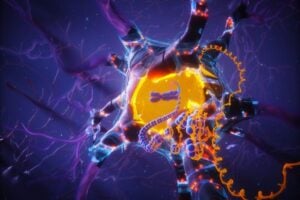
This image is an artistic representation of how APOE2 promotes resilience to cellular senescence maintaining the integrity of DNA and the nuclear envelope. We show a neuron protected by APOE2 represented as orange dots across the cell, with a blue mesh representing the resistance to senescence. We highlight in golden the integrity of the nucleus and the protected genome.

APOE2 Keeps Neurons Young by Fixing Their DNA Before It Falls Apart

concrete cement

Electricity Trick Could Make Concrete Almost Carbon-Free

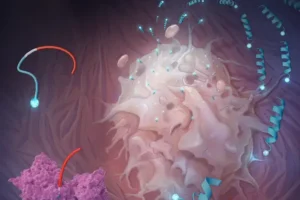
The new drug carrier (shown as blue-red strands) is split by an enzyme (purple structure), delivering the therapeutic (blue spheres) to a cancerous cell.

A Molecular Grappling Hook Could Keep Cancer Drugs Trapped Inside Tumors

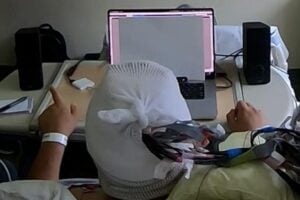
A hearing system monitoring this man’s brain activity amplifies a conversation played on his left while quieting one on his right, based on which conversation his brainwaves suggest he is paying attention to.

Scientists Have Built a Hearing System That Tunes In to Whatever Your Brain Is Focusing On

spicolli fast times at ridgemont high

Why Regular Cannabis Users Have Lower Rates of Type 2 Diabetes

a museum scene

Visiting a Museum Once a Week Slows Biological Aging as Much as Regular Exercise

Older posts
Newer posts
← Previous Page1 … Page7 Page8 Page9 … Page5,959 Next →
Substack subscription form sign up

Comments

  • Sue Ann Hayes on Hidden Nuclear Protein Fuels Pancreatic Cancer’s Deadly Aggression
  • Curtis Webber on The GPS-Killer? This Quantum Device ‘Feels’ Motion Like a Brain—Down to the Atomic Level
  • Ran on How the Age You First Had Sex Could Shape How You Age Decades Later
  • Sparty on How the Age You First Had Sex Could Shape How You Age Decades Later
  • Josh Mitteldorf on A Single TV Segment Sent Leucovorin Prescriptions for Autistic Children Soaring 2,000 Percent
© 2026 ScienceBlog.com | Follow our RSS / XML feed