Skip to content
ScienceBlog.com
  • Featured Blogs
    • EU Horizon Blog
    • ESA Tracker
    • Experimental Frontiers
    • Josh Mitteldorf’s Aging Matters
    • Dr. Lu Zhang’s Gondwanaland
    • NeuroEdge
    • NIAAA
    • SciChi
    • The Poetry of Science
    • Wild Science
  • Topics
    • Brain & Behavior
    • Earth, Energy & Environment
    • Health
    • Life & Non-humans
    • Physics & Mathematics
    • Social Sciences
    • Space
    • Technology
  • Our Substack
  • Follow Us!
    • Bluesky
    • Threads
    • FaceBook
    • Google News
    • Twitter/X
  • Contribute/Contact
When metals are placed in magnetic fields, their electrons orbit at speeds and in shapes related to the metal's atomic lattice. MIT researchers have discovered “moiré crystals” with two different competing atomic lattices, which together generate a moiré superlattice that is mathematically equivalent to an emergent 4D “superspace” lattice. Researchers have now discovered that some of the electronic properties of moiré crystals simulate those of previously hypothesized 4D quantum materials.

Electrons in New Crystals Behave as If They Live in Four Dimensions

newborn baby sleeping

Injectable Particle Makes Surgery Safer for Newborns

man looking in mirror

Being with a Narcissist Does Not Ruin Relationships in the Way Scientists Thought

Scientists looking for sources that generated life on Earth are considering hydrothermal vents of different types, from vents found in the deep sea to others created by meteor impacts.

The Asteroids That Ended the Dinosaurs May Also Have Helped Start Life

An artist’s conception of the gas giant planet TOI-5205 b orbiting a small, cool red dwarf star.

A Giant Planet That Should Not Exist Has an Atmosphere That Makes Even Less Sense

At Brussels’ EU science fair, children sketch new inventions and eavesdrop on bacteria

native american dice

Native Americans Were Gambling, Exploring Probability Millenia Before Their Old World Counterparts

abstract illustration of identical tiles

A Physics Trick Could Make Quantum Computers Far Cheaper to Build

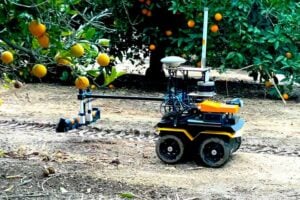
A robot designed to assist with precision irrigation in action, in a citrus orchard.

Orchard Robot Waters Each Tree Just Right. That’s a Big Deal.

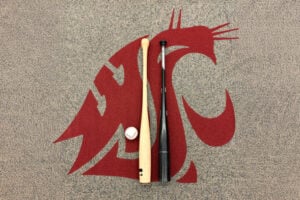
In the first-ever laboratory experiments done on the bat, a research team determined that the torpedo bat and traditional bat perform equally well in hitting power with only a slight difference in the location of the bat’s sweet spot.

Nine Home Runs, One Weird-Shaped Bat, and a Physics Lab That Burst the Bubble

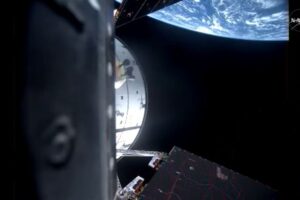
A view of the Earth’s horizon from NASA’s Orion spacecraft as it orbits above the planet during the first hours of the Artemis II test flight. NASA astronauts Commander Reid Wiseman, Pilot Victor Glover, and Mission Specialist Christina Koch, and CSA (Canadian Space Agency) astronaut Mission Specialist Jeremy Hansen, launched at 6:35 p.m. EDT on Wednesday, April 1, 2026, on an approximately 10-day mission around the Moon and back to Earth.

NASA Sends Humans Around the Moon Again, Starting with a Blinking Toilet Light

an eye looking through an opening in a brick wall

Being in Two Places at Once Is Not Just a Quantum Quirk. It Happens to Real Atoms, Too

abstract illustration of a key opening a lock

Quantum Computers Could Crack Bitcoin’s Encryption in Nine Minutes. The Clock Is Already Running

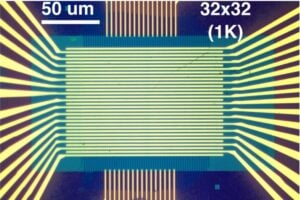
Optical image of a 32 × 32 (1K) crossbar array based on Gra/HfOx/W devices using a two-wire configuration.

Atom-Thin Layer Lets Computer Chips Survive Temperatures Hotter Than Lava

Older posts
Newer posts
← Previous Page1 … Page12 Page13 Page14 … Page5,949 Next →
Substack subscription form sign up

Comments

  • Marco Messina on More Than a Third of Americans Have Lost Relationships Over Politics
  • Anon on Why Fructose Behaves Less Like a Calorie and More Like a Hormone
  • Mark Mellinger on Living Plastic Can Self-Destruct on Command
  • Marie Feret on The Silent Frequency That Makes Old Buildings Feel Haunted
  • Dax on The Silent Frequency That Makes Old Buildings Feel Haunted
© 2026 ScienceBlog.com | Follow our RSS / XML feed