Skip to content
ScienceBlog.com
  • Featured Blogs
    • EU Horizon Blog
    • ESA Tracker
    • Experimental Frontiers
    • Josh Mitteldorf’s Aging Matters
    • Dr. Lu Zhang’s Gondwanaland
    • NeuroEdge
    • NIAAA
    • SciChi
    • The Poetry of Science
    • Wild Science
  • Topics
    • Brain & Behavior
    • Earth, Energy & Environment
    • Health
    • Life & Non-humans
    • Physics & Mathematics
    • Social Sciences
    • Space
    • Technology
  • Our Substack
  • Follow Us!
    • Bluesky
    • Threads
    • FaceBook
    • Google News
    • Twitter/X
  • Contribute/Contact

Physics & Mathematics

Dr. Rupak Mahapatra, an experimental particle physicist, holds a TESSERACT detector. The highly sensitive devices, which are fabricated at Texas A&M University, are deepening the search for dark matter and have potential applications in quantum computing.

Silicon Crystals Are Whispering to Themselves, and It’s Messing Up the Dark Matter Hunt

quantum vs traditional file writing

Quantum Computing Gets Its First Real Backup System

Artist’s impression of a forming galaxy cluster in the early Universe: radio jets from active galaxies are embedded in a hot intracluster atmosphere (red), illustrating a large thermal reservoir of gas in the nascent cluster.

The Galaxy Cluster That Got Too Hot, Too Fast

hybrid heavy truck

Fuel Cell Catalysts Change the Rules as Voltage Rises

a distant planet appearing as a speck of light in the night sky

Astronomers Finally Weigh a Rogue Planet Drifting Alone Through the Galaxy

The inside of the DIII-D fusion vessel. The iridescent hues seen on some tiles lining the vessel come from atoms that can become lodged in the walls during plasma experiments.

Fusion Reactors Could Crack Dark Matter Mystery That Stumped TV Physicists

diagram of the process

Chemists Solve Decades-Old Problem in Molecular Shape Control

This illustration shows how superconductivity from vanadium (yellow) is transformed at the magnesium oxide barrier (green), enabling iron (blue) to form same-spin electron pairs and participate in Josephson-junction-like behavior.

Ferromagnet Mimics Superconductor in Quantum Computing Surprise

a jumble of numbers

A 40-Year Math Rule Just Learned to Handle Infinity

Artist's impression of a rare trio of merging galaxies, J121/1219+1035, which host three actively feeding, radio-bright supermassive black holes and whose jets light up the surrounding gas.

Three Black Holes Gorge Simultaneously in Colliding Galaxies

abstract illustration of a human heart and power lines

Blood-Flow Logic Tames Renewable Grid Chaos

abstract illustration of numbers' effect on brain

Small Numbers Trick Your Brain Into Seeing Left

anyon waves

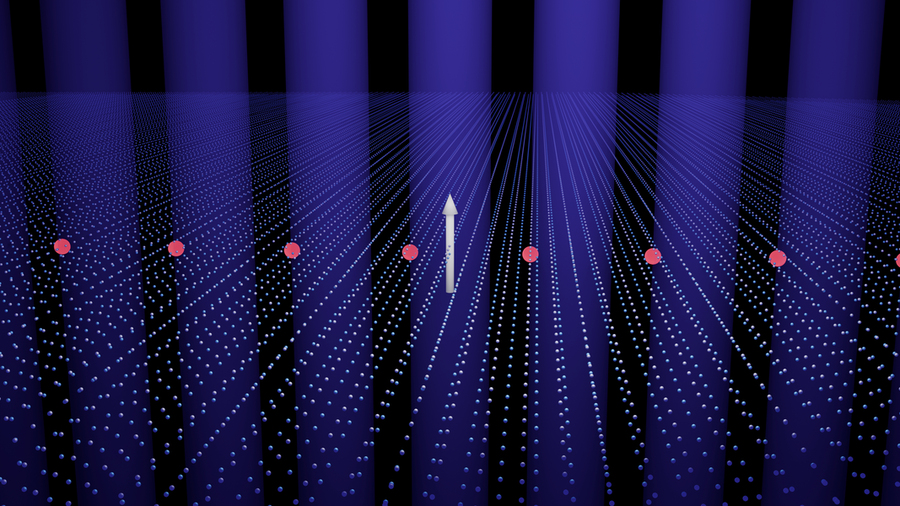
Exotic Particles Called Anyons Unlock New Path to Superconductivity

Four 3D structures, pictured on bottom, were transformed from flat configurations made of interconnected tiles (top) with a single pull of a string. The middle row shows, in red, the optimized string path and lift points for each object.

The Flat-Pack Building That Assembles With One Pull

Older posts
Newer posts
← Previous Page1 … Page7 Page8 Page9 … Page526 Next →
Substack subscription form sign up

Comments

  • Marie Feret on The Silent Frequency That Makes Old Buildings Feel Haunted
  • Dax on The Silent Frequency That Makes Old Buildings Feel Haunted
  • Karoly Mirnics on Common Prescription Drugs May Disrupt Cholesterol Pathways in the Womb and Raise Autism Risk
  • Aizen on Laziness helped lead to extinction of Homo erectus
  • Norwood johnson on Electrons in New Crystals Behave as If They Live in Four Dimensions
© 2026 ScienceBlog.com | Follow our RSS / XML feed